Portable Exercise Equipment: The Complete 2026 Guide
Not enough space for a home gym? You do not need one. Portable exercise equipment lets you build real strength, burn calories, and stay consistent using tools that fit in a drawer, a backpack, or a suitcase. From resistance bands to suspension trainers, these compact tools bring gym level results into apartments, hotel rooms, and offices. This guide breaks down what portable exercise equipment actually is, the main types available in 2026, and how to choose pieces that match your goals, space, and budget. You will also find a comparison table, buying criteria, and answers to the questions people ask most. By the end, you will know exactly which portable exercise equipment fits your life and how to use it to build a home gym routine that actually sticks.
Table of Contents
What Is Portable Exercise Equipment?
Portable exercise equipment refers to any fitness tool designed to be lightweight, compact, and easy to move, store, or travel with, unlike traditional gym machines that are bulky, bolted down, or require a dedicated room. This category includes resistance bands, suspension trainers, adjustable dumbbells, portable cable machines, jump ropes, and small accessories like sliders and ab rollers. For a broader look at how these tools fit alongside the full range of gym equipment types, it helps to see the category by footprint first: most portable pieces weigh under 20 pounds, fold or roll up, and can be packed into a bag, closet, or car trunk without special tools or a permanent setup.
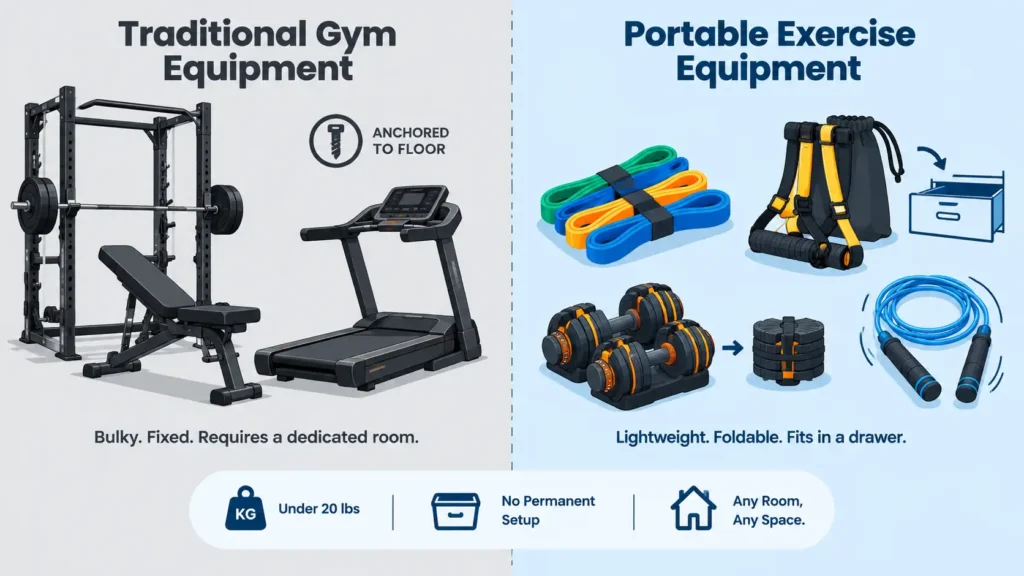
The rise of portable fitness equipment reflects a shift in how people actually live and train. Renters, apartment dwellers, frequent travelers, and remote workers often lack access to a garage or spare room for a squat rack and bench press, yet they still want to train consistently. Manufacturers responded by re-engineering resistance mechanisms, using dense elastic bands, quick release cable systems, and adjustable weight plates, so a five pound piece of gear can now replicate 50 to 300 pounds of resistance. This means portability no longer requires sacrificing training intensity, which is a meaningful shift from how home fitness worked even a decade ago.
It also helps to understand what portable equipment is not. A treadmill, even a foldable one, is not typically classified as portable because it still requires a fixed space and significant weight to move. Similarly, a full power rack or Olympic barbell setup falls outside this category regardless of how it is marketed. True portable exercise equipment prioritizes three things at once: low weight, small storage footprint, and no permanent installation, which is why suspension trainers that anchor to a door and resistance bands that loop around a chair leg are the clearest examples of the category in action.
Why People Choose Portable Fitness Equipment
The biggest driver behind portable fitness equipment adoption is space constraint. According to U.S. Census Bureau housing data, the median size of a newly built apartment has shrunk over the past decade, and a growing share of Americans now live in units under 750 square feet. In that kind of space, a squat rack or elliptical simply is not realistic, but a resistance band set that lives in a drawer is. Portable equipment solves the space problem without asking people to give up strength training altogether, which is why it has become the default entry point for renters and city dwellers building their first home workout routine.
Cost is the second major factor. A single suspension trainer or a set of resistance bands typically costs between 20 and 250 dollars, compared to 1,000 dollars or more for a basic multi station home gym, and there is no delivery, assembly, or floor space cost attached. This lower barrier to entry means more people can start strength training immediately rather than saving for months or committing to a gym membership they may not use consistently. If you are weighing that decision, our home gym essentials guide for beginners breaks down exactly where to start and what to skip when building a first setup.
Travel and lifestyle flexibility round out the picture. Frequent travelers, military personnel, remote workers, and people who relocate often cannot rely on a fixed piece of equipment staying useful for long. Portable gear travels with the person instead of the person adapting around the equipment, which supports consistency, arguably the single biggest predictor of fitness results. A few additional reasons people choose portable equipment include:
- No long term contract or subscription required, unlike many gym memberships
- Faster setup and teardown, often under two minutes
- Easier to share within a household since pieces are lightweight and interchangeable
- Lower risk of injury from improper machine setup, since most portable tools rely on controlled bodyweight or elastic resistance
Types of Portable Exercise Equipment
Portable exercise equipment spans a wide range of categories, each targeting different training goals, from building raw strength to improving cardiovascular endurance to supporting mobility and recovery. Understanding the main types helps you avoid buying redundant gear and instead build a small collection that covers strength, cardio, and mobility without overlap, in the same way our complete guide to every machine and tool maps out equipment choices for a full sized gym. Most portable fitness collections fall into five broad categories: resistance bands and tubes, suspension trainers, adjustable dumbbells and kettlebells, portable cable or functional trainers, and smaller accessories like jump ropes, sliders, and ab rollers.
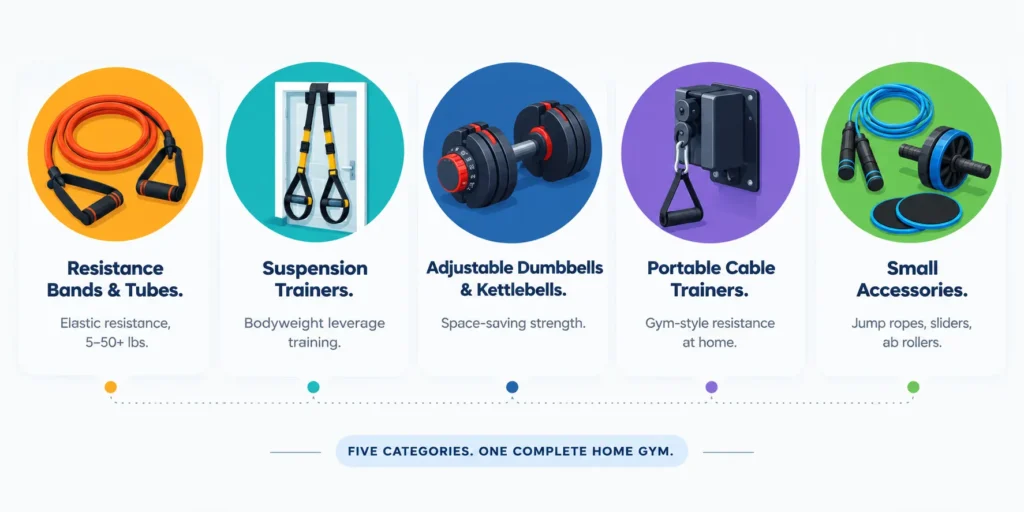
Each category uses a different resistance mechanism, which matters more than most people realize. Resistance bands rely on elastic tension that increases as the band stretches, suspension trainers use your own bodyweight and leverage angle, adjustable dumbbells use physical weight plates, and cable trainers use tensioned pulley systems that mimic gym cable machines. Because the resistance type differs, the muscle activation pattern and training effect also differ, which is why a well rounded portable gym usually combines at least two categories rather than relying on just one.
The sections below break down each type in detail, covering how it works, who it is best suited for, and what to look for when buying. This progression moves from the most beginner friendly and affordable options toward more advanced, higher resistance tools, so you can match your selection to your current fitness level and budget.
Resistance Bands and Tubes
Resistance bands and tubes are the most widely used form of portable exercise equipment because they are inexpensive, lightweight, and effective across nearly every muscle group. They work through elastic resistance, meaning the tension increases the further the band stretches, which creates a strength curve that is different from free weights but still builds muscle and improves strength when used consistently. Bands typically come in two forms: flat loop bands, often used for glute and hip work, and tube bands with handles, which are better suited for pressing and pulling movements like chest presses, rows, and bicep curls.
Resistance levels are usually color coded, ranging from extra light, around 5 to 10 pounds of resistance, up to heavy or extra heavy bands that can simulate 50 pounds or more. This range makes bands genuinely useful for beginners rehabilitating an injury as well as advanced lifters adding accommodating resistance to a barbell lift. A 2019 study published in the Journal of Sports Science and Medicine found that resistance band training produced strength gains comparable to conventional resistance training equipment in previously untrained adults, which supports their credibility as a legitimate training tool rather than just a beginner accessory. Bands also pair naturally with the small tools covered in our exercise and fitness accessories guide, since most complete portable setups combine several accessory categories rather than relying on one.
When choosing resistance bands, look for a few key factors:
- Material quality: latex bands offer more elasticity, while fabric covered bands resist snapping and rolling
- Handle durability: stitched or molded handles last longer than glued attachments
- Resistance range: a set with 3 to 5 resistance levels covers more training scenarios than a single band
- Door anchor compatibility: useful for rows, presses, and lat pulldown style movements at home
The main limitation of bands is inconsistent resistance at the very start and end of a movement, which is why they work best paired with bodyweight or dumbbell training rather than as a sole strength tool for advanced lifters.
Suspension Trainers
Suspension trainers use two adjustable straps anchored to a door, bar, tree branch, or ceiling mount to let you perform bodyweight exercises at variable angles of difficulty. Unlike resistance bands, which add external tension, suspension trainers manipulate your own bodyweight as the resistance source, meaning the more horizontal your body position becomes during a push or pull movement, the harder the exercise gets. This makes them uniquely scalable: a single suspension trainer can challenge a complete beginner and a competitive athlete simply by adjusting body angle and strap length.
Suspension training also emphasizes core stability more than most other portable equipment types, since nearly every exercise requires you to stabilize your body in an unsupported position. Movements like suspended rows, chest presses, pistol squats, and pikes engage stabilizer muscles that traditional machines often bypass because a machine controls the movement path for you. This is one reason suspension trainers are popular with personal trainers, physical therapists, and military fitness programs, and it is a category worth reading up on in our strength training equipment guide, which covers how bodyweight leverage training compares to free weight progression.
Setup typically takes under a minute using a door anchor, and most systems support 300 to 350 pounds of bodyweight resistance, verified through load testing on carabiners and webbing straps. Key features to evaluate when choosing a suspension trainer include:
- Anchor point flexibility: door anchors, ceiling mounts, and outdoor anchor straps expand where you can train
- Strap material and stitching: nylon webbing with locking adjusters holds up better over time than basic straps
- Included workout guidance: many systems include an app or printed guide, which helps beginners who are unfamiliar with bodyweight leverage training
- Weight capacity rating: confirm the carabiner and strap rating matches or exceeds your bodyweight with a safety margin
The main tradeoff is a learning curve. Because difficulty depends on body angle rather than an added weight, new users sometimes need a few sessions to understand how small positional changes significantly affect exercise intensity.
Adjustable Dumbbells and Kettlebells
Adjustable dumbbells and kettlebells solve one of the biggest space problems in strength training: a full dumbbell rack going from 5 to 50 pounds can take up an entire wall, while a single adjustable pair covers the same weight range in the footprint of two shoeboxes. These systems use a dial, pin, or selector mechanism to change the loaded weight in seconds, replacing what would otherwise be 10 to 15 separate pairs of fixed weights. Most consumer adjustable dumbbell sets range from 5 to 55 pounds per hand, which is enough resistance for the vast majority of home strength training goals, from general fitness to hypertrophy focused lifting.
Kettlebells bring a different training stimulus because their offset center of mass, with the weight sitting below the handle rather than centered like a dumbbell, forces more grip and stabilizer engagement during swings, cleans, and presses. Portable kettlebell options include adjustable kettlebells that change weight through a twist lock mechanism, as well as compact fixed weight kettlebells designed with a lower profile for easier storage. For a side by side look at how these fit into a broader shopping list, see our best home exercise equipment buying guide, which compares dumbbells and kettlebells against other home strength options.
When shopping for adjustable weight systems, prioritize these factors:
- Weight increment size: 2.5 pound jumps allow more precise progressive overload than 5 pound jumps
- Adjustment speed: dial based systems are faster to switch than pin loaded plate systems
- Build quality: steel internal mechanisms tend to outlast plastic housed versions under regular use
- Footprint when stored: some systems come with a stand or tray to prevent rolling and floor damage
The primary downside is upfront cost. Adjustable systems are more expensive per pound of resistance than a used fixed weight set, though the space savings and long term versatility typically justify the price for anyone without a dedicated weight room.
Portable Cable and Functional Trainers
Portable cable and functional trainers are compact, all in one resistance machines that replicate the pulley based resistance of a commercial cable machine in a device that often weighs under 10 pounds. Instead of a weight stack, these systems use resistance mechanisms like magnetic tension, hydraulic pistons, or dense internal springs to generate resistance that can range from a few pounds up to 300 pounds in some models. The cable output attaches to interchangeable handles, ankle straps, or bars, which lets users mimic gym cable exercises like chest presses, rows, tricep pushdowns, and lat pulldowns from a wall mount, door anchor, or floor position.
What sets this category apart from bands and suspension trainers is consistent resistance throughout the entire range of motion, closer to how a real cable machine behaves rather than the variable tension of elastic bands. This matters for lifters focused on hypertrophy or strength progression, since consistent resistance allows for more predictable overload from session to session. Many portable cable trainers also pair with companion apps that track workouts and log progress over time, a feature worth comparing across manufacturers using our guide to the best fitness equipment brands before committing to a specific system.
Key factors to evaluate before buying a portable cable trainer include:
- Maximum resistance output: confirm the top resistance level matches your long term strength goals, not just your current level
- Attachment variety: more handle, strap, and bar options mean more exercise variety from one unit
- Portability specs: weight, dimensions, and whether it includes a carrying case matter if you plan to travel with it
- App and subscription costs: some systems require a paid subscription for full workout programming, which changes the real cost of ownership
The main limitation is price relative to bands or basic dumbbells, since portable cable trainers are mechanically more complex, and lower end models can suffer from inconsistent resistance calibration or connector wear over heavy use.
Jump Ropes, Sliders, Ab Rollers and Small Accessories
Not every effective piece of portable exercise equipment needs to involve resistance training. Small accessories like jump ropes, core sliders, and ab rollers round out a portable gym by covering cardiovascular conditioning, core strength, and mobility, often at a fraction of the cost and weight of the equipment covered earlier. A basic jump rope, for example, weighs only a few ounces yet delivers a cardio workout that research from the American Council on Exercise has shown can burn calories at a rate comparable to running, an approach detailed further in our gym equipment cardio names guide, while also improving coordination and calf and shoulder endurance through repetitive rotational movement.
Core sliders, small discs that fit under the hands or feet on hardwood or carpet, allow for controlled, low impact movements like mountain climbers, lunges, and plank slides that build core stability without any added equipment weight beyond the discs themselves. Ab rollers, a wheel with two handles, work the entire anterior core chain, including the rectus abdominis and obliques, more intensely than most crunch variations because the rolling motion forces the body to resist extension through a longer range of motion. Both tools cost under 25 dollars in most cases and fit into a single drawer, making them ideal starter purchases for anyone building a portable gym on a tight budget.
Other small accessories worth including in a well rounded portable collection are:
- Push up bars, which reduce wrist strain and increase chest range of motion during push ups
- Agility ladders, useful for footwork, coordination, and light cardio conditioning
- Massage or foam rollers, which support recovery and reduce muscle soreness between training sessions
- Compact yoga or exercise mats, which protect joints during floor based movements and roll up for easy storage
While these accessories rarely build significant strength on their own, they fill important gaps, cardio, core, mobility, and recovery, that resistance focused tools like bands and dumbbells do not address as directly, which is why most complete portable gym setups include at least two or three items from this category.
Benefits of Portable Exercise Equipment
The clearest benefit of portable exercise equipment is that it removes the biggest barriers people cite for not exercising: lack of space, lack of time, and lack of money. A 2023 survey by the Physical Activity Council found that convenience and accessibility are among the top factors influencing whether people maintain a regular workout routine, and portable equipment directly addresses both. When a resistance band or suspension trainer is already in the room, a 20 minute workout becomes something you can start immediately rather than something that requires driving to a gym, waiting for equipment, and driving back, which removes several points of friction that commonly cause people to skip sessions.
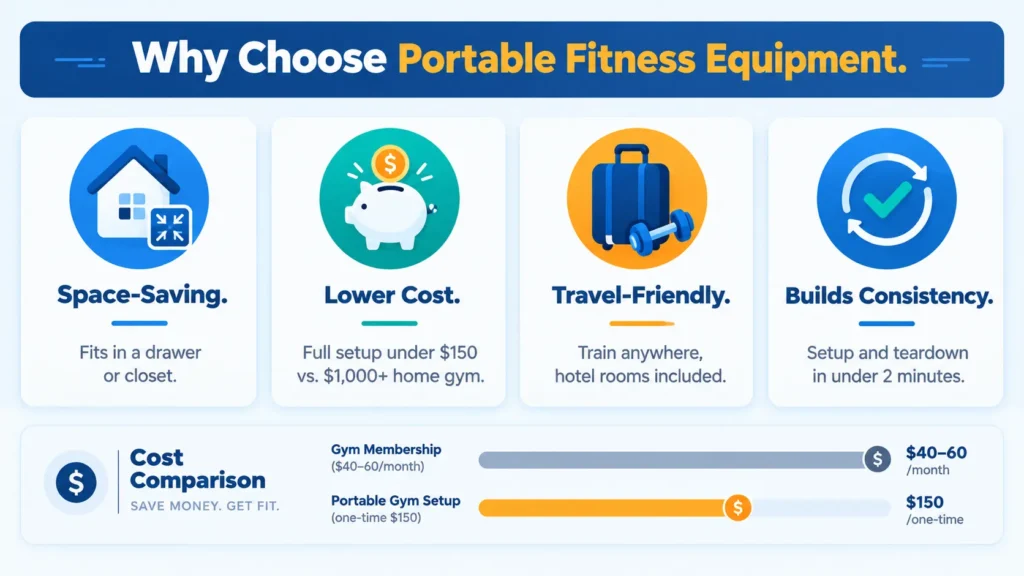
Cost efficiency is another major advantage that compounds over time. Where a basic gym membership in the United States averages between 40 and 60 dollars a month, a complete portable gym setup, combining resistance bands, a suspension trainer, and a jump rope, can often be assembled for under 150 dollars as a one time cost. This financial predictability makes portable equipment especially attractive for anyone also exploring options in our best gym equipment for weight loss guide, since sustainable habits matter more for results than any single piece of equipment.
Portable exercise equipment also supports training consistency in a way fixed equipment cannot. Because the gear travels with the person, someone who works from home three days a week and travels for work the other two can maintain the exact same training program regardless of location, which research consistently links to better long term adherence and results than sporadic, location dependent training. Additional benefits worth highlighting include:
- Lower injury risk for beginners, since most portable tools rely on controlled, self limited resistance rather than heavy fixed loads
- Family and household flexibility, since lightweight gear can be shared or adjusted for different users and fitness levels
- Scalability, allowing a user to start with light resistance and progressively add heavier bands, dumbbells, or advanced movements as strength improves
- Minimal setup and cleanup time, often under two minutes, which supports habit formation by reducing the effort required to begin a session
How to Choose the Right Portable Exercise Equipment
Choosing the right portable exercise equipment starts with identifying your primary training goal, since no single piece of gear covers strength, cardio, and mobility equally well. Someone focused on building muscle should prioritize resistance bands, adjustable dumbbells, or a portable cable trainer, since these tools allow for progressive overload, the gradual increase in resistance over time that drives strength and muscle gains. Someone focused on general fitness, weight management, or cardiovascular health may get more value from a jump rope, agility ladder, or a suspension trainer used for higher repetition, full body circuits.
Space and storage constraints should be evaluated next, since the entire point of portable equipment is that it fits your living situation rather than the other way around. A helpful practical exercise is to physically measure the storage space available, whether that is a closet shelf, a drawer, or a corner of a room, before buying anything. Equipment that requires a permanent anchor point, like some suspension trainers and cable systems, also needs a suitable door frame, wall stud, or ceiling mount, so confirming that a workable anchor point exists at home is worth doing before purchase rather than after.
Budget and long term cost should factor in beyond the sticker price. Some portable equipment, particularly smart cable trainers and app connected systems, carry ongoing subscription costs for full workout programming, which can add 10 to 20 dollars a month on top of the initial purchase. Comparing the total first year cost, not just the upfront price, gives a clearer picture of value, and our guide on where to buy gym equipment is a useful reference for comparing retailers, warranties, and return policies before you commit.
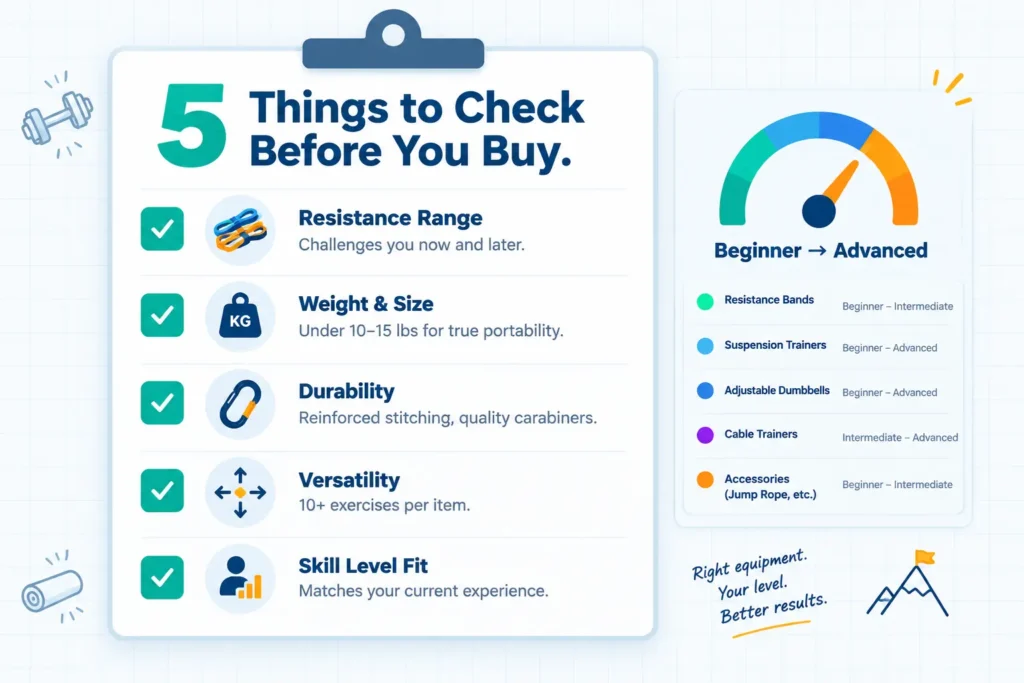
Key criteria to weigh when narrowing down options include:
- Resistance range: does the equipment offer enough resistance to challenge you now and as you get stronger
- Weight and dimensions: confirm it genuinely fits your definition of portable, ideally under 10 to 15 pounds for true travel use
- Durability and materials: check for reinforced stitching, quality carabiners, and warranty length, since cheaper materials fail faster under regular use
- Versatility: equipment that supports 10 or more distinct exercises delivers more long term value than single purpose tools
- Skill level fit: beginners benefit from equipment with lower entry resistance and clear instructional support, while advanced users should prioritize maximum resistance ceiling
Reading verified buyer reviews and, where possible, testing equipment in person before buying can also reveal build quality issues that are not obvious from product photos or marketing copy alone.
Portable Exercise Equipment for Different Goals
Different fitness goals call for different combinations of portable equipment, and matching gear to a specific objective produces far better results than buying a generic bundle and hoping it fits every need. For pure strength building, adjustable dumbbells, heavy resistance bands, and a suspension trainer form the strongest combination, since they allow progressive overload through increasing weight, band tension, or leverage angle. Someone training for strength should prioritize equipment with a higher resistance ceiling, since lighter tools designed for rehabilitation or general toning will plateau quickly once a base level of strength is established, typically within the first two to three months of consistent training.
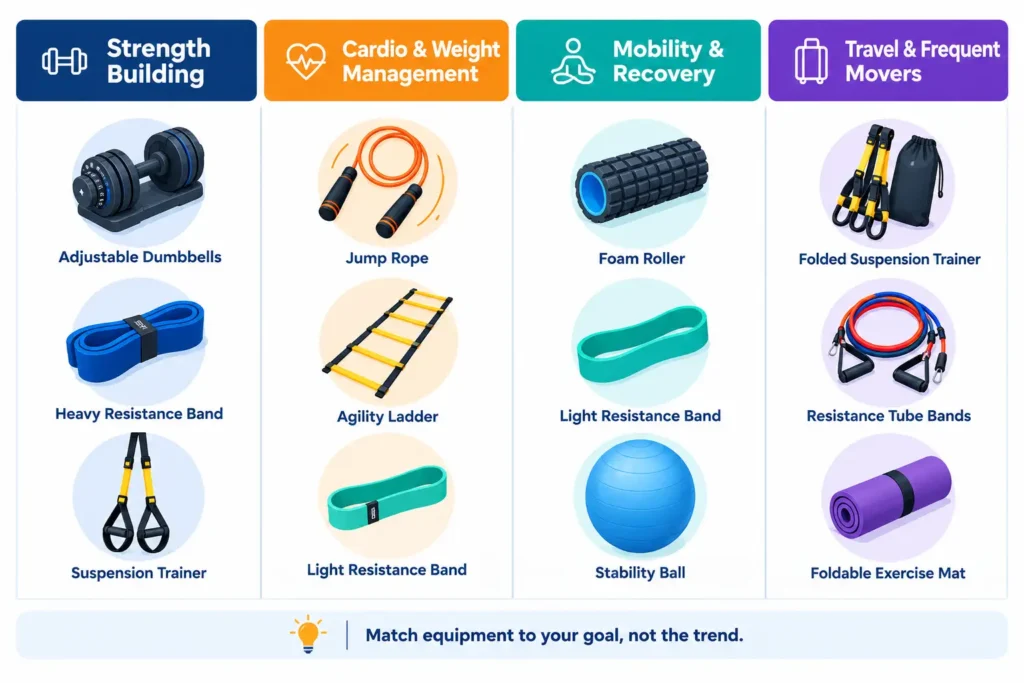
For cardiovascular and weight management goals, jump ropes, agility ladders, and lighter resistance bands used in circuit style training deliver more value than heavier strength focused tools. High repetition circuits combining bodyweight movements with light band resistance elevate heart rate effectively while remaining low impact, which matters for people managing joint issues or returning to exercise after a period of inactivity. Readers focused specifically on this goal may also want our best gym equipment for weight loss for women guide, which addresses common concerns around strength training and body composition in more depth.
For mobility, recovery, and rehabilitation focused goals, the equipment priorities shift again. Light resistance bands, foam rollers, and stability balls support controlled, low load movement patterns that are commonly used in physical therapy settings to rebuild strength safely after injury or surgery. Frequent travelers and anyone who trains outdoors have a slightly different priority list, favoring the lightest and most compact options regardless of category, which our outdoor fitness equipment guide covers in more detail for training in heat, humidity, and variable outdoor conditions.
A practical breakdown by goal looks like this:
- Strength building: adjustable dumbbells, heavy resistance bands, suspension trainer
- Cardio and weight management: jump rope, agility ladder, light to medium resistance bands
- Mobility and recovery: light resistance bands, foam roller, stability ball
- Travel and frequent movers: resistance tube bands, a compact suspension trainer, a foldable mat
- Beginners just starting out: a light to medium resistance band set paired with a suspension trainer, since both scale well as fitness improves
How to Build a Small Portable Home Gym
Building a small portable home gym works best as a staged process rather than a single large purchase, since starting with a core set of versatile tools and expanding gradually prevents wasted money on equipment that ends up unused. The first stage, typically costing between 50 and 100 dollars, should focus on maximum versatility per dollar spent: a medium resistance band set, a jump rope, and a compact exercise mat. This combination alone supports full body strength circuits, cardio conditioning, and floor based core work, covering the three fitness pillars, strength, cardio, and mobility, well enough to sustain a consistent routine for the first two to three months of training.
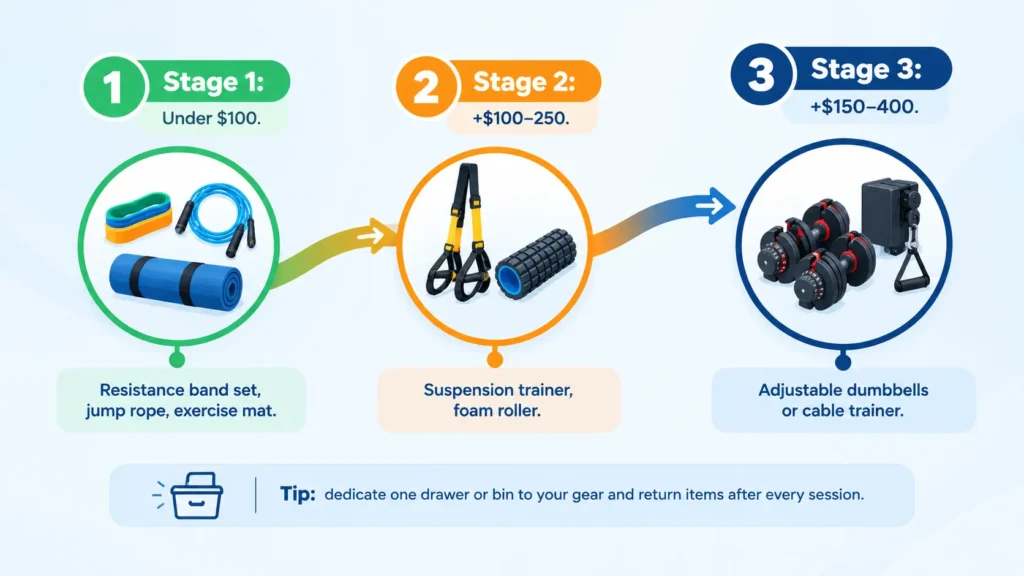
The second stage, once a consistent habit is established, typically adds 100 to 250 dollars of equipment that increases resistance ceiling and exercise variety. A suspension trainer is usually the highest value addition at this stage, since it unlocks dozens of new bodyweight exercise variations and scales in difficulty as strength improves, without requiring more storage space than the first stage items combined. Adjustable dumbbells are the next logical addition for anyone whose goals have shifted toward visible muscle growth, a transition covered step by step in our home gym equipment for weight loss guide, since bodyweight and band resistance alone eventually become insufficient to continue driving results for more experienced trainees.
Storage strategy deserves its own attention, since a poorly organized portable gym quickly becomes clutter that discourages use rather than supporting it. A simple, repeatable system works better than an elaborate one: dedicate a single drawer, under bed storage bin, or closet shelf exclusively to fitness equipment, and return every item to that spot after each session. This small habit removes the two minute search and setup friction that often causes people to skip workouts on busy days. A sample beginner to intermediate build looks like this:
- Stage 1, under $100: resistance band set, jump rope, foldable exercise mat
- Stage 2, $100 to $250 added: suspension trainer, foam roller
- Stage 3, $150 to $400 added: adjustable dumbbells or a portable cable trainer, depending on strength goals
- Storage: one dedicated bin, drawer, or shelf, with equipment returned immediately after each use
This staged approach also naturally builds workout knowledge over time, since users typically master bodyweight and band based movement patterns before progressing to heavier resistance tools, which reduces injury risk compared to buying advanced equipment before developing proper form.
Common Mistakes to Avoid
One of the most common mistakes people make with portable exercise equipment is overbuying before establishing a consistent habit. It is tempting to purchase a full set of bands, a suspension trainer, adjustable dumbbells, and a cable system all at once, but research on habit formation consistently shows that starting small and building consistency matters more for long term results than having access to more equipment. A large upfront purchase can also create decision fatigue, where too many options at once makes it harder to commit to a simple, repeatable routine, which ironically reduces the odds of sticking with training rather than improving them.
Ignoring resistance progression is another frequent error, particularly with resistance bands. Many people buy a single band or a single resistance level and continue using it long after their strength has outpaced that resistance, which stalls progress without the user realizing why results have plateaued. Just like free weights, resistance tools need to increase in difficulty over time to continue driving adaptation, so a band set with multiple resistance levels, or a plan to add heavier bands every few months, is necessary for continued improvement rather than a one time purchase that lasts indefinitely.
Safety related mistakes, particularly around anchoring, also deserve attention. Suspension trainers and some cable systems rely on a secure anchor point, and using a weak door hinge, a loose curtain rod, or an unrated hook can lead to equipment failure mid exercise, which carries real injury risk given that many suspension exercises are performed at an angle where a sudden loss of support could cause a fall. Always confirm anchor points are rated for at least your bodyweight plus a safety margin, and inspect straps, carabiners, and bands regularly for wear. If you are still deciding what to buy in the first place, our gym equipment for sale guide outlines how to avoid overpaying or ending up with poor quality secondhand gear.
Additional mistakes worth avoiding include:
- Skipping instructional guidance for less intuitive tools like suspension trainers, which have a steeper learning curve than free weights
- Storing equipment out of sight, which reduces the likelihood of consistent use compared to keeping it visible and accessible
- Choosing based on price alone, since the cheapest bands and straps often fail faster, creating a hidden long term cost
- Neglecting warm up and mobility work, assuming that because equipment is lightweight, injury risk is automatically low
Comparison Table: Popular Portable Equipment Types
Comparing portable exercise equipment side by side makes it easier to see how each type fits different budgets, goals, and living situations, especially since the categories covered earlier differ significantly in resistance mechanism, price, and skill requirements. The table below summarizes the core decision factors covered throughout this guide into a single reference point, and pairs well with our gym equipment names with pictures guide if you want to see what each piece of equipment actually looks like before buying.
| Equipment Type | Typical Price Range | Space Needed | Best For | Skill Level | Resistance Range |
| Resistance Bands and Tubes | $15 to $60 | Minimal (fits in a drawer) | Beginners, rehab, full body strength | Beginner to intermediate | Approx. 5 to 50+ lbs |
| Suspension Trainer | $60 to $250 | Minimal (needs anchor point) | Functional strength, core stability, travel | Beginner to advanced | Bodyweight based, up to 300+ lbs capacity |
| Adjustable Dumbbells | $150 to $400 | Small (two units, tray optional) | Muscle building, strength progression | Intermediate to advanced | Approx. 5 to 55 lbs per hand |
| Adjustable Kettlebells | $100 to $300 | Small (one unit) | Ballistic movements, grip and core strength | Intermediate to advanced | Approx. 10 to 50+ lbs |
| Portable Cable or Functional Trainer | $200 to $600 | Small (wall or floor mount) | Gym style resistance training at home | Intermediate to advanced | Approx. 5 to 300 lbs |
| Jump Rope | $10 to $30 | Negligible | Cardio, coordination, travel | Beginner to advanced | Bodyweight cardio |
| Ab Roller or Sliders | $10 to $30 | Negligible | Core strength, stability | Beginner to intermediate | Bodyweight based |
| Foam Roller | $15 to $40 | Minimal | Recovery, mobility, muscle soreness | All levels | Not applicable |
This comparison highlights a clear pattern worth noting for anyone building a portable gym: the lowest cost and lowest skill barrier options, bands, jump ropes, and sliders, also tend to require the least space, making them the natural starting point regardless of long term goals. As budget and experience grow, adding a suspension trainer or adjustable dumbbells extends both resistance range and exercise variety without a significant increase in storage footprint, which is the core advantage portable equipment holds over traditional home gym setups.
Frequently Asked Questions
What is portable exercise equipment?
Portable exercise equipment refers to lightweight, compact fitness tools designed for easy storage and transport, such as resistance bands, suspension trainers, and adjustable dumbbells. Unlike traditional gym machines, it requires no permanent installation, typically weighs under 20 pounds, and fits in a drawer, closet, or travel bag.
What is the best portable exercise equipment for beginners?
Resistance bands and suspension trainers are the best starting points for beginners. Both scale in difficulty as strength improves, cost under 100 dollars combined, and carry lower injury risk than heavier free weights, making them ideal for building foundational strength and proper movement patterns first.
Can you build a full home gym with portable equipment only?
Yes, a combination of resistance bands, a suspension trainer, adjustable dumbbells, and small accessories can cover strength, cardio, and mobility training completely. Many users train effectively for years using only portable equipment, especially when resistance levels are increased progressively over time.
Is portable exercise equipment as effective as gym machines?
Portable equipment can be equally effective for most fitness goals, since studies show resistance band training produces comparable strength gains to conventional equipment in untrained adults. Gym machines offer higher maximum resistance ceilings, which matters mainly for advanced strength athletes pursuing very heavy loads.
How much does portable exercise equipment cost?
A basic setup with resistance bands, a jump rope, and a mat costs between 50 and 100 dollars. A more complete portable gym, adding a suspension trainer and adjustable dumbbells, typically ranges from 200 to 500 dollars as a one time purchase.
What portable exercise equipment is best for small apartments?
Resistance bands, a suspension trainer, and a foldable mat are ideal for apartments, since all three store in a small drawer or closet and require no permanent floor space. A door anchor allows suspension training without drilling into walls.
What is the best portable exercise equipment for travel?
Resistance tube bands and a compact suspension trainer are the top travel choices, since both weigh under two pounds, pack flat in a suitcase, and require only a door or sturdy anchor point to use anywhere, including hotel rooms.
Do resistance bands really build muscle?
Yes, resistance bands build muscle by creating progressive tension throughout a movement, which stimulates the same muscle growth mechanisms as free weights. Research published in the Journal of Sports Science and Medicine confirms comparable strength outcomes between band and conventional resistance training in untrained adults.
How much weight can a suspension trainer hold?
Most quality suspension trainers support 300 to 350 pounds of bodyweight resistance, based on manufacturer load testing of straps and carabiners. Always check the specific weight rating before use, and inspect straps and hardware regularly for wear.
How do I store portable exercise equipment in a small space?
Dedicate one drawer, closet shelf, or under bed bin exclusively to fitness gear, and return every item there after each session. This consistent storage habit reduces setup friction and makes it more likely equipment gets used regularly. If you are still shopping for pieces to fill that space, our exercise equipment stores near me guide can help you compare local and online options.
Conclusion
Portable exercise equipment makes consistent training possible no matter where you live, work, or travel. Whether you start with a simple resistance band set or build up to a suspension trainer and adjustable dumbbells, the right combination of tools can cover strength, cardio, and mobility without needing a dedicated gym room. The key is matching equipment to your actual goals, space, and budget, then progressing resistance over time rather than buying everything at once. For a deeper walkthrough of building out a complete setup once you have mastered the portable basics, see our home gym equipment buyer’s guide. As home fitness continues to evolve heading into 2026, expect portable exercise equipment to keep closing the gap with traditional gym setups through smarter resistance mechanisms and more compact designs. Start small, stay consistent, and let your equipment grow alongside your fitness level rather than the other way around.