Best Home Exercise Equipment: The Complete 2026 Buying Guide
Building a home gym used to mean guessing which machine would actually get used and which one would become a coat rack within a month. The good news: the best home exercise equipment in 2026 is smarter, more compact, and easier to match to your goals than ever before, so that guesswork is largely gone.
Whether you’re working with a spare bedroom or a corner of an apartment, the right mix of strength, cardio, and recovery gear can replace a full gym membership without dominating your living space. For a broader look at building out a full setup room by room, our Home Gym Equipment: The Complete Buyer’s Guide for 2026 is a useful companion to this guide. In short: adjustable dumbbells, resistance bands, a compact cardio machine, and one recovery tool cover most people’s needs, with upgrades layered in as goals grow.
This guide breaks down exactly what to buy, in what order, and why, based on your space, budget, and fitness level, so every dollar you spend actually gets used. By the end, you’ll know exactly which category of equipment to prioritize first, how much to budget realistically, and which common buying mistakes to avoid.
Table of Contents
How to Choose the Best Home Exercise Equipment for Your Goals
The best home exercise equipment isn’t the priciest or the most popular. It’s the piece you’ll actually use three months from now. Before buying anything, get clear on four factors: your primary fitness goal, available space, budget, and experience level.
Start with goal. Someone training for strength needs different tools than someone chasing cardio endurance or mobility. Trying to cover every goal with one machine usually leads to disappointment. A runner training for a race gets far more value from a treadmill or walking pad than from a squat rack, while someone rebuilding strength after months off gets more from dumbbells and bands than from a rowing machine.
Space is the second filter, and it’s often underestimated. Measure the actual area you plan to use before buying anything larger than a yoga mat’s footprint. A piece of equipment that looks compact in a product photo can feel completely different once it’s sitting in a studio apartment or a shared living room. If you’re unsure, tape out the equipment’s dimensions on your floor first.
A simple filter to run every purchase through:
- Goal fit: Does this equipment directly support strength, cardio, or recovery, the way you train?
- Space fit: Can it fold, stack, or tuck away when not in use?
- Budget fit: Does the price match how often you’ll realistically use it?
- Skill fit: Can you use it safely and correctly as a beginner, or does it require coaching?
Beginners generally do best starting with versatile, low-skill equipment like adjustable dumbbells and resistance bands before adding machines like cable trainers or squat racks. This keeps early investment low while you build the habit, then lets you upgrade with intention once you know what you’ll stick with.
Experience level also shapes safety. Barbell squat racks and heavy free weights require proper form to avoid injury, so beginners benefit from starting with guided or lower-skill equipment and adding technical movements once they’ve built a base of strength and confidence, ideally with input from a trainer or reliable instructional resource.
Best Strength Training Equipment for Home Workouts
Strength training is where most home gyms start, and for good reason: it builds muscle, protects joints, and supports every other fitness goal. The good news is you don’t need a garage full of iron to get real results. For a deeper category breakdown, see our Strength Training Equipment: The Complete 2026 Guide.
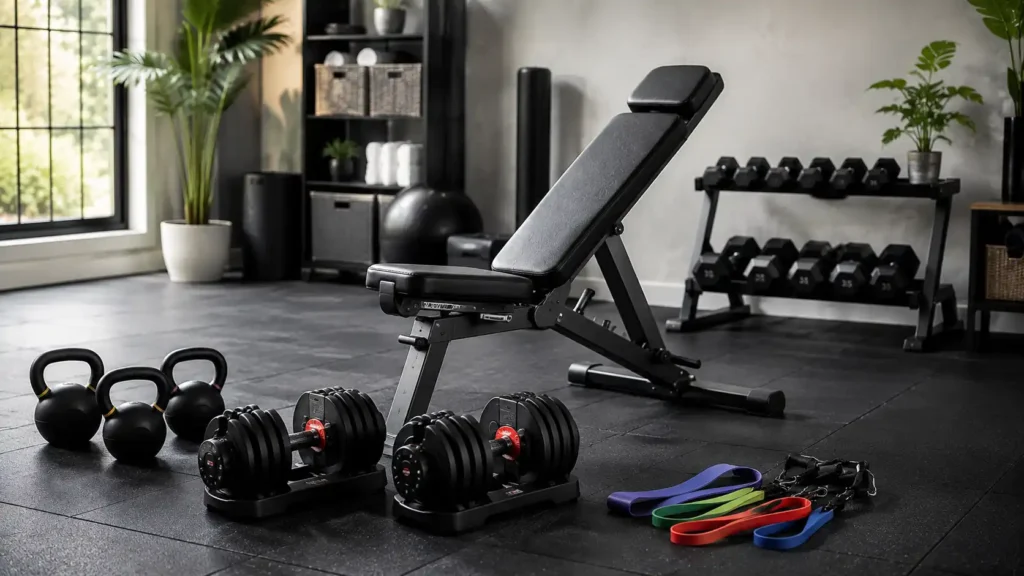
Adjustable dumbbells are the single best investment for most people. A compact pair can replace an entire rack of fixed weights, typically covering a 5 to 50+ pound range in one unit. They’re ideal for presses, rows, curls, and lunges, and they store in a fraction of the space traditional dumbbells need.
Resistance bands are the most underrated piece of strength equipment. They add load to bodyweight moves like squats, glute bridges, and lateral walks, cost very little, and roll up small enough to fit in a drawer. Look for fabric or looped bands that stay in place during movement rather than rolling up your legs.
For people ready to go further, two options stand out:
- Foldable squat racks: wall-mounted, fold flat when not in use, support barbell training including squats and bench presses
- Cable or functional trainers: offer the widest exercise variety of any single machine, often including a pull-up station, and work well in a corner footprint
Kettlebells deserve a mention too. A single kettlebell supports swings, goblet squats, and presses, training strength and cardio conditioning at the same time. They take up less space than a dumbbell set and are especially useful for full-body, time-efficient workouts.
Beginners should master dumbbells and bands first. Add a rack or trainer only once you’ve outgrown that range of resistance. A practical progression looks like this: start with a moderate dumbbell range and bands for two to three months, track whether you’re consistently increasing resistance, and only then consider a rack or functional trainer if you’re running out of load or exercise variety.
Best All-in-One Home Gyms and Smart Gyms
For people who want structure without buying separate equipment for every movement, all-in-one home gyms and smart gyms solve two problems at once: variety and space.
Traditional functional trainers use dual weight stacks or plates to deliver a full cable machine experience in a compact, often corner-friendly frame. They typically support presses, pulls, curls, and pull-ups from a single unit, making them one of the most versatile pieces of equipment you can own. The trade-off is price and a slightly steeper learning curve for cable-based movements compared to free weights.
Smart gyms take a different approach, using digital resistance instead of physical plates. They pair with an app for guided workouts, automatically adjust resistance in real time, and track progress without you doing the math. This makes them a strong fit for beginners who want built-in coaching, though the ongoing subscription cost is worth factoring into your budget.
Which one fits depends on preference:
- Choose a functional trainer if you want maximum exercise variety and don’t need built-in coaching
- Choose a smart gym if you’re newer to strength training and want guided programming
- Skip both if your space or budget favors dumbbells and bands instead, since these all-in-one systems work best as an upgrade, not a starting point
Installation is worth planning for as well. Functional trainers and wall-mounted smart gyms often need a stud-anchored mount or a dedicated section of wall, so renters should check with a landlord before installing anything permanent. Freestanding versions of both exist and are worth the small premium if you expect to move within a few years.
Best Cardio Equipment for Home Workouts
Cardio equipment keeps your heart healthy, burns calories, and complements any strength routine, but the right choice depends heavily on space and impact preference. If you want to compare machine types side by side first, our Gym Equipment Cardio Names: The Complete 2026 Guide walks through each option in detail.
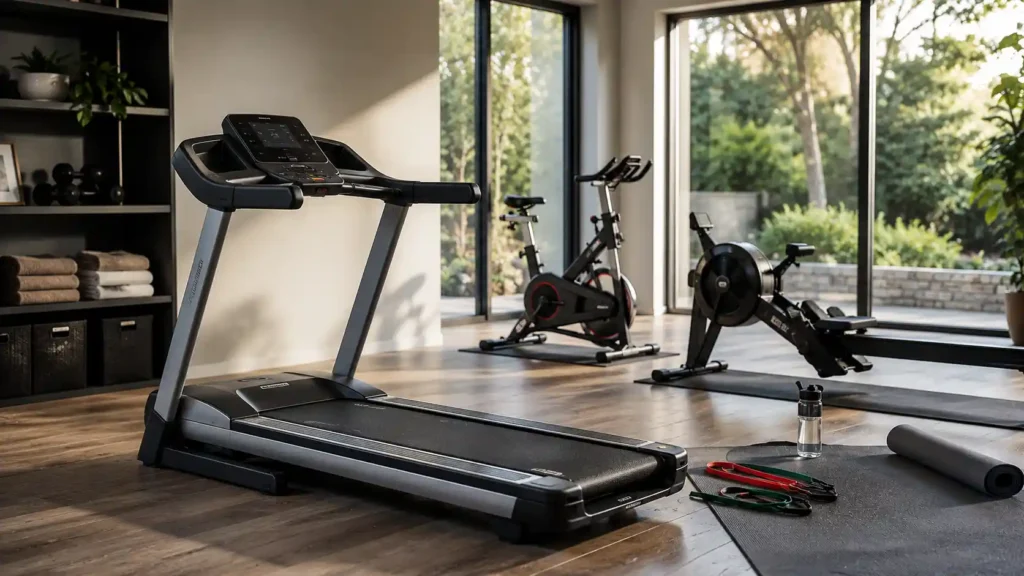
Treadmills and walking pads remain the most popular option for a reason: they’re familiar, low-skill, and effective for both walking and running. Foldable models and slim walking pads solve the space problem, sliding under a bed or couch when not in use.
Exercise bikes offer low-impact cardio that’s easier on joints than running, with adjustable resistance for both light rides and intense intervals. Many now include screens or app connectivity for guided classes, though a basic model works just as well for building the habit.
Rowing machines deliver a full-body cardio workout, engaging legs, back, and arms in a single motion. Foldable rowers store upright against a wall, making them a smart pick for smaller rooms.
For minimal space and cost, two options stand out for efficiency:
- Weighted jump ropes: intense cardio in a drawer-sized footprint, though they require some skill and floor clearance
- Mini steppers: closet-sized cardio that’s beginner-friendly and low-impact
Choose based on impact tolerance, available floor space, and whether you prefer steady-state or interval-style training. People managing joint pain or recovering from injury generally do better with bikes, rowers, or steppers, while those training for running events benefit more from time on a treadmill or walking pad, even if it means sacrificing some space efficiency.
Cardio equipment also has a consistency advantage over outdoor training: weather, daylight, and safety concerns never get in the way of a workout you can do at home. That reliability alone is often the difference between a habit that sticks and one that fades after a few cold or rainy weeks.
Best Compact Equipment for Small Spaces and Apartments
Limited square footage doesn’t mean limited results. The key to an apartment-friendly setup is choosing equipment that does more than one job and disappears when you’re done.
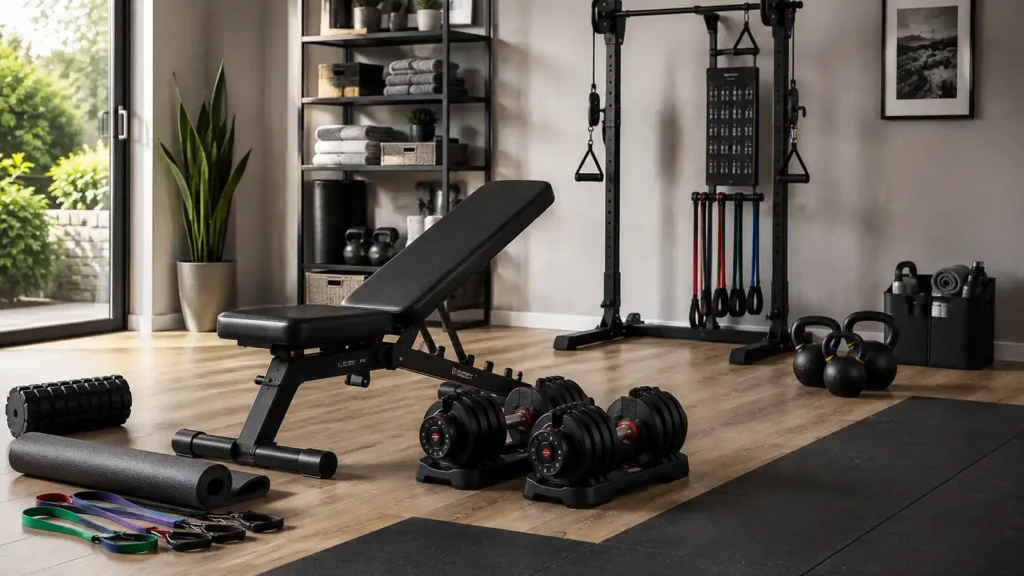
Multi-use gear beats single-purpose machines every time in a small space. Prioritize pieces that fold, stack, or tuck into a closet, and avoid anything that needs a dedicated corner permanently.
Apartment-friendly essentials worth prioritizing:
- Adjustable dumbbells: replace an entire weight rack in the footprint of two blocks
- Resistance bands: zero floor space, store in a drawer, cover full-body training
- Foldable squat racks: wall-mounted, fold flat, support serious strength work without a permanent footprint
- Mini steppers or under-desk ellipticals: closet-sized cardio for low-impact movement
- Suspension trainers: hook onto a door and store flat, ideal for HIIT-style circuits
Noise matters too, especially for shared walls or downstairs neighbors. Rubber-coated plates, a thick mat under equipment, and low-impact machines like bikes or steppers over jump ropes or heavy free weights all help keep workouts neighbor-friendly.
Vertical storage is the final piece: hang bands on hooks, lean mats against a wall, and keep dumbbells on a low shelf rather than the floor. A small space stays functional only when equipment has a defined home between sessions.
It also helps to think in terms of a dedicated workout zone rather than a workout room. A five-foot by five-foot cleared area, even in a living room or bedroom corner, is enough space for most strength and bodyweight routines. Marking that zone mentally, or with a mat that only comes out during workouts, makes it easier to start a session without needing to rearrange furniture first.
Best Recovery and Mobility Equipment
Recovery isn’t optional, it’s part of the training process. Skipping it is one of the most common reasons people plateau or get injured, and a few inexpensive tools go a long way toward fixing that.
Massage guns use percussive therapy to loosen tight muscles and speed recovery after tough sessions. A compact, mini-sized version handles most needs without the price tag or bulk of a full-size model, making it easy to keep in a gym bag or nightstand drawer.
Yoga mats support more than yoga. A quality mat cushions joints during floor work, stretching, and mobility drills, and it’s the one piece of equipment nearly every workout style relies on. Look for a thick, non-slip mat that holds up to daily use.
Foam rollers and mobility bands round out a basic recovery kit. Foam rolling before or after a workout helps release muscle tightness, while mobility bands assist with stretches that are hard to do unassisted, like hip openers and shoulder stretches.
A simple recovery routine doesn’t need to be complicated:
- Foam roll or use a massage gun on sore muscle groups for 1 to 2 minutes each
- Stretch major muscle groups used that day for 5 to 10 minutes
- Prioritize sleep and hydration, since equipment enhances recovery but doesn’t replace it
How Much Should You Spend on Home Exercise Equipment
Budget matters more than brand names when building a home gym. The good news is that effective training doesn’t require a large upfront investment, and spending strategically beats spending fast.
Under $200: A yoga mat, a set of resistance bands, and one pair of medium-weight dumbbells cover roughly 90 percent of effective home training. This tier is ideal for beginners testing whether a home workout routine will actually stick before spending more.
$200 to $600: This range adds adjustable dumbbells, a compact cardio option like a mini stepper or jump rope, and a basic recovery tool like a mini massage gun. It’s the sweet spot for most consistent home exercisers, covering strength, cardio, and recovery without a dedicated gym room.
$600 and up: This tier is for people who’ve proven consistency and want to scale up, think foldable squat racks, functional trainers, treadmills, or smart gym systems. These are upgrades, not starting points, and are best purchased once you know your training style well enough to justify the cost.
A practical rule: buy the cheapest version of a category first, use it consistently for a month or two, then upgrade only the pieces that get real use. This prevents the common mistake of overspending on equipment that ends up unused.
It’s also worth comparing home equipment costs against a gym membership over time. A mid-range gym membership often runs $40 to $60 a month, which adds up to $480 to $720 a year. A one-time investment in the $200 to $600 range for home equipment frequently pays for itself within the first year, especially once commuting time and missed sessions due to bad weather or a crowded gym floor are factored in.
Sample Home Gym Setups by Fitness Level
Seeing how equipment fits together in practice makes the buying decision easier. Here’s how a setup typically evolves as consistency and goals grow.
Beginner setup, roughly $150 to $250: one pair of medium-weight dumbbells or an entry-level adjustable set, a set of resistance bands, and a yoga mat. This covers full-body strength and mobility work three to four times a week and is enough to build a lasting habit before spending more.
Intermediate setup, roughly $400 to $700: adjustable dumbbells with a wider weight range, a kettlebell, a compact cardio machine such as a mini stepper or exercise bike, and a mini massage gun for recovery. This tier supports structured strength progression alongside regular cardio sessions.
Advanced setup, roughly $1,000 and up: a foldable squat rack or functional trainer, a treadmill or rower, a full recovery kit including foam roller and massage gun, and an expanded dumbbell or plate range. This tier suits people who train five or more days a week and want a setup that rivals a commercial gym.
The point of laying it out this way isn’t to rush toward the advanced tier. Most people get excellent results staying in the beginner or intermediate range indefinitely, especially when paired with consistent effort and good programming.
How to Maintain Your Home Exercise Equipment
Buying durable equipment only pays off if it’s maintained properly. A few minutes of upkeep each month significantly extends the life of strength and cardio equipment alike.
- Wipe down dumbbells, bands, and machine frames after use to prevent sweat corrosion on metal parts and degradation on rubber and fabric
- Check resistance bands regularly for small tears or thinning, since a snapped band under tension can cause injury
- Lubricate moving parts on rowers, bikes, and cable machines according to the manufacturer’s schedule, usually every few months
- Tighten bolts and pins on squat racks and benches periodically, since normal use can loosen hardware over time
- Store equipment away from direct sunlight and humidity when possible, both of which degrade rubber, foam, and upholstery faster
Treat maintenance as part of the investment, not an afterthought. Equipment that’s cared for typically lasts years longer than the same product used and stored carelessly, which means fewer replacement purchases over time.
Durability and Buying Mistakes to Avoid
Even great equipment fails to deliver results if it breaks down, wobbles, or gets abandoned after a few weeks. A few buying mistakes show up again and again, and most are easy to avoid.
What to look for in build quality:
- All-metal construction over plastic components, especially for adjustable dumbbells and cable machines
- Welded joints rather than bolted ones on racks and frames, since welds hold up better under repeated stress
- Weight capacity that exceeds your current needs, giving you room to progress without replacing equipment
- A clear warranty, ideally one year or longer, as a sign the manufacturer trusts its own product
Common mistakes to avoid:
- Buying a machine before testing whether you’ll actually use the exercise style it’s built for
- Choosing the biggest, most expensive option first instead of starting small and scaling based on real use
- Ignoring noise level for apartment or shared-wall living, which often leads to equipment sitting unused
- Skipping recovery tools entirely, which increases injury risk and slows progress over time
The equipment that delivers the best long-term value isn’t always the flashiest. It’s the piece built well enough to handle years of regular use, matched to a training style you’ll actually stick with.
When comparing similar products, read the fine print on weight capacity and materials rather than relying on marketing language alone. A resistance band listed at a certain pound rating and a dumbbell frame rated for a specific weight range both tell you more about long-term reliability than star ratings or review counts, which can be inconsistent across retailers.
Frequently Asked Questions
What is the minimum equipment needed for a home workout?
A yoga mat, a set of resistance bands, and one pair of medium weight dumbbells cover most effective home training. This basic setup costs under $200 and supports strength, mobility, and light cardio work, making it a smart starting point before investing in anything more specialized.
What is the best home exercise equipment for beginners?
Adjustable dumbbells and resistance bands are the best starting point for beginners. They’re low skill, versatile across muscle groups, and affordable, letting new exercisers build consistency before adding machines like squat racks or functional trainers that require more experience.
Are adjustable dumbbells worth it compared to a full weight set?
Yes, especially in limited space. Adjustable dumbbells replace an entire rack of fixed weights in the footprint of two blocks, often covering a 5 to 50+ pound range. They cost more upfront than a basic pair but save significant space and money long term.
What is the best home exercise equipment for small apartments?
Foldable, stackable gear works best in apartments: adjustable dumbbells, resistance bands, foldable squat racks, and mini steppers. Prioritize equipment that tucks into a closet or against a wall when not in use, and choose low-impact options to stay neighbor-friendly.
How much should I budget for home exercise equipment?
Most people should start under $200 with a mat, bands, and dumbbells, then expand to $200 to $600 for cardio and recovery tools once the habit sticks. Equipment costing $600 or more is best treated as an upgrade, not a starting purchase.
What is the quietest home exercise equipment for apartments?
Resistance bands, yoga mats, and low-impact machines like exercise bikes or mini steppers are the quietest options. Rubber-coated plates and a thick mat under equipment further reduce noise, which matters most for shared walls or downstairs neighbors.
Can you build muscle with home workout equipment alone?
Yes. Adjustable dumbbells, resistance bands, and bodyweight training provide enough progressive overload to build muscle effectively at home. Consistency and gradually increasing resistance matter more than access to a full commercial gym setup.
What home exercise equipment lasts the longest?
Equipment with all-metal construction, welded joints, and higher weight capacities than you currently need tends to last longest. Plastic components and bolted frames wear out faster under regular use, so build quality matters more than brand recognition.
Is a smart gym worth it compared to traditional equipment?
Smart gyms are worth it for beginners who want guided coaching and automatic resistance adjustment, though they come with a subscription cost. Traditional dumbbells, bands, and functional trainers offer similar strength results at a lower long-term price.
What equipment should I buy first when starting a home gym?
Start with adjustable dumbbells and resistance bands, then add a compact cardio option and a basic recovery tool like a foam roller. Reserve larger purchases like squat racks or smart gyms until you’ve proven consistency with the basics.
Conclusion
The best home exercise equipment isn’t about buying the most gear, it’s about buying the right gear for your space, goals, and budget, and actually using it. Start small with adjustable dumbbells, resistance bands, and a mat, then layer in cardio and recovery tools as your routine solidifies. Save bigger investments like squat racks or smart gyms for once you’ve proven consistency.
As home fitness continues evolving into 2026, the equipment that wins isn’t the flashiest, it’s the piece built to last and matched to how you actually train. Get the fundamentals right first, and every future upgrade will be one you actually use.
Ready to build your setup? Start with one piece of equipment this week rather than waiting for the perfect full gym, momentum matters more than a complete collection on day one. The habit you build with a simple setup today is what makes every future upgrade worthwhile.