Arm Workout Equipment Names The Complete 2026 Guide
Standing in front of a row of unfamiliar arm machines can make even a simple workout feel confusing. Learning the right arm workout equipment names solves that problem instantly, helping you train with purpose instead of guessing which machine does what.
This guide breaks down every major arm and shoulder machine you will encounter in a commercial gym, from bicep and tricep focused equipment to shoulder press and chest press machines that also build arm strength. You will learn what each machine targets, how to use it correctly, and which one fits your specific goal.
In short, arm workout equipment names fall into four main categories: bicep machines, tricep machines, shoulder machines, and supporting equipment like the chest press and cable machine. By the end of this guide, you will know exactly which machine to reach for on arm day.
Arm Workout Equipment Names at a Glance
If you need a fast reference, here are the most common arm workout equipment names, organized by the muscle group each one targets.
| Machine Name | Primary Muscle Targeted | Difficulty Level | Typical Price Range |
| Bicep Curl Machine | Biceps | Beginner | $500 to $2,000 |
| Preacher Curl Machine | Biceps | Beginner | $400 to $1,800 |
| Cable Bicep Curl | Biceps | Beginner | $1,500 to $4,000 |
| Tricep Pushdown Machine | Triceps | Beginner | $1,000 to $3,000 |
| Tricep Dip Machine | Triceps, shoulders, chest | Intermediate | $1,000 to $3,500 |
| Cable Tricep Kickback | Triceps | Beginner | $1,500 to $4,000 |
| Shoulder Press Machine | Deltoids | Beginner | $800 to $3,000 |
| Lateral Raise Machine | Side deltoids | Beginner | $700 to $2,500 |
| Rear Delt Machine | Rear deltoids | Beginner | $700 to $2,500 |
| Chest Press Machine | Chest, triceps, shoulders | Beginner | $800 to $3,000 |
| Assisted Pull Up Machine | Back, biceps | Intermediate | $2,000 to $5,000 |
| Seated Row Machine | Back, biceps, forearms | Beginner | $700 to $2,500 |
| Lat Pulldown Machine | Back, biceps | Beginner | $800 to $2,800 |
This table covers the equipment you will find in almost every commercial gym. Chest and back machines appear here too because they engage the arms significantly, even though their primary purpose targets other muscle groups.
Why Understanding Arm Machine Names Matters
Knowing arm workout equipment names is not just about sounding knowledgeable at the gym. It directly affects how effectively you train and how confidently you move through your workout. complete gym equipment names guide
When you understand what a machine is called and what it does, you can plan a balanced arm and shoulder routine instead of randomly picking equipment based on what looks familiar. This matters because the arms contain several distinct muscle groups, including biceps, triceps, deltoids, and forearms, and neglecting any one of them creates strength imbalances over time.
Correct terminology also improves communication with personal trainers and gym staff. Telling a trainer you want to work on the preacher curl machine gets a far more accurate response than describing it vaguely as the arm bending machine.
Finally, machine names often signal proper usage. A seated row machine tells you both the position and the target muscle group in one phrase, reducing guesswork and helping you approach unfamiliar equipment with more confidence rather than avoiding it entirely.
Bicep Focused Machines
The biceps sit at the front of the upper arm, and several dedicated machines exist to isolate and build this muscle group effectively.
Bicep Curl Machine
The bicep curl machine is one of the most recognized arm workout equipment names. You sit with your upper arms resting against a padded support, grip the handles, and curl the weight upward using only your forearms. Keeping your elbows fixed against the pad throughout the movement is essential, since swinging your body to lift the weight reduces bicep engagement significantly.
This machine works well for beginners because the guided path removes the balance and stabilization demands of free weight curls, letting you focus entirely on muscle contraction.
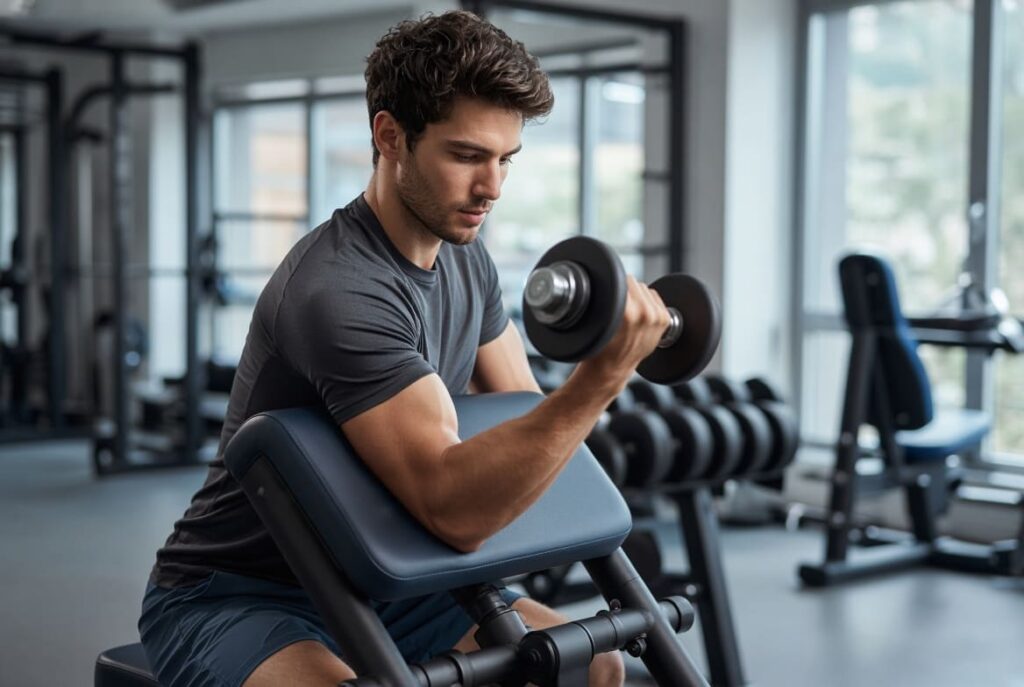
Preacher Curl Machine
The preacher curl machine locks your arms into an angled position over a padded support, which stretches the bicep more deeply at the bottom of each rep compared to a standard curl. This extended range of motion often produces a stronger contraction and a more noticeable pump.
Because the angled pad prevents any body momentum from assisting the lift, this machine demands strict form, making it particularly effective once you have built a basic strength foundation.
Cable Bicep Curl
Cable bicep curls use a pulley system that keeps tension on the biceps throughout the entire movement, unlike free weights where tension decreases at certain points in the range of motion. Standing tall and curling the bar or handle toward your chest, then lowering it with control, produces a steady, consistent muscle building stimulus that many lifters find superior for long term growth.
Tricep Focused Machines
The triceps make up roughly two thirds of the upper arm’s mass, making dedicated tricep equipment essential for anyone focused on arm size and strength. toning equipment for women
Tricep Pushdown Machine
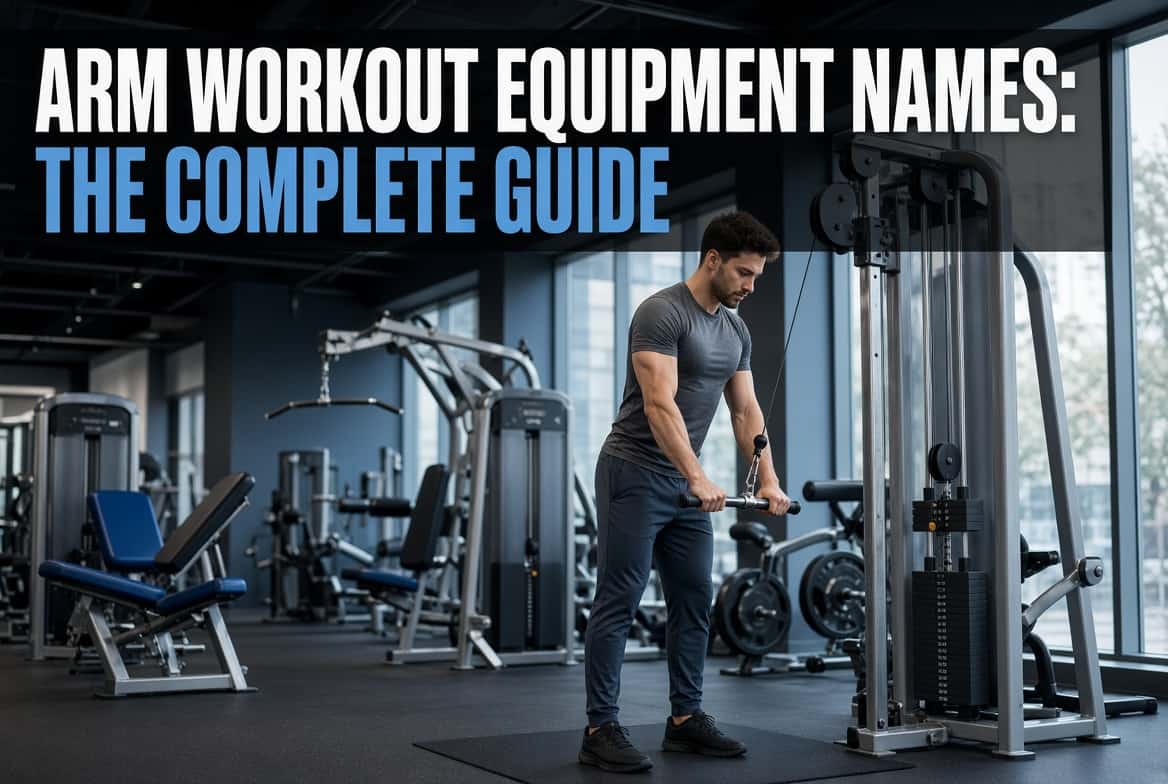
The tricep pushdown, performed at a cable station, involves pushing a bar or rope attachment downward until your arms are fully extended, then allowing it to rise slowly. Keeping your elbows tucked close to your body throughout the movement isolates the triceps effectively and prevents your shoulders from taking over the exercise.
This machine accepts multiple attachment types, including straight bars, angled bars, and rope handles, each shifting the emphasis slightly across the three tricep heads.
Tricep Dip Machine
The tricep dip machine replicates the bodyweight dip movement with adjustable resistance, making it accessible to beginners who cannot yet perform full bodyweight dips. You grip the handles and press your body downward, engaging the triceps, shoulders, and chest simultaneously.
This machine serves as an excellent stepping stone toward unassisted dips, gradually building the strength needed to progress to the free weight version of the exercise.
Cable Tricep Kickback
The cable tricep kickback targets the triceps through a controlled extension movement performed while bent slightly at the hips. Keeping your elbow pinned close to your side, you extend your arm backward against the cable’s resistance until it reaches full extension.
This exercise particularly emphasizes the long head of the tricep, contributing to the visible shape and definition many people associate with toned arms.
Shoulder Focused Machines
The shoulders, made up of three distinct deltoid heads, require targeted equipment to develop fully and avoid injury from imbalanced training.
Shoulder Press Machine
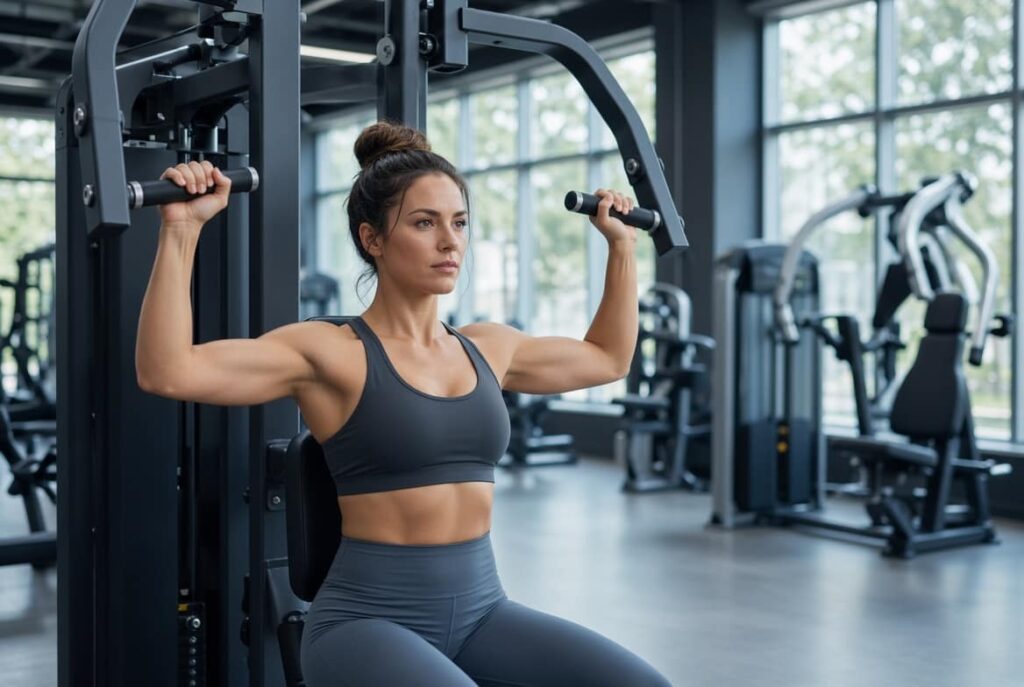
The shoulder press machine guides an overhead pressing motion, primarily targeting the front and side deltoids. You sit with your back supported, grip the handles at shoulder height, and press upward until your arms are extended, then lower with control.
The fixed path of this machine reduces the stabilization demands of a free weight overhead press, making it a safer entry point for beginners or anyone returning to training after a shoulder injury.
Lateral Raise Machine
The lateral raise machine isolates the side deltoids through an outward lifting motion, building the width that creates broader looking shoulders. Sitting with your arms positioned against the pads, you lift outward to shoulder height before lowering slowly.
This machine removes the momentum that often creeps into free weight lateral raises, ensuring the side deltoids do the work rather than your traps or lower back.
Rear Delt Machine
The rear delt machine, sometimes called a reverse fly machine, targets the often neglected rear deltoids through a pulling motion performed while facing into the pads. This muscle group plays a key role in shoulder health and posture, yet it receives far less direct attention than the front and side deltoids in most routines.
Regular rear delt training helps balance shoulder development and reduces the risk of injury caused by overdeveloped front deltoids pulling the shoulders forward.
Chest Machines That Also Work the Arms
While chest machines primarily target the pectoral muscles, several also provide significant secondary engagement for the arms, making them relevant to any complete arm and shoulder routine.
Chest Press Machine
The chest press machine guides a horizontal pressing motion similar to a bench press, working the chest as the primary muscle while the triceps and front deltoids assist heavily throughout the movement. Sitting with your back against the pad, you press the handles forward until your arms extend, then return with control.
Because the triceps handle a substantial portion of the pressing work, particularly toward the end range of the movement, the chest press machine indirectly builds tricep strength and size alongside its primary chest focused benefit. This makes it a valuable addition to an arm day routine even though it is technically categorized as chest equipment.
Back and Pull Machines That Build Arm Strength
Pulling movements engage the biceps and forearms significantly, making back focused machines an important part of complete arm development.
Assisted Pull Up Machine
The assisted pull up machine uses a counterweight system to reduce the amount of bodyweight you lift, making pull ups accessible to those who cannot yet perform the unassisted version. Kneeling or standing on the platform, you grip the handles and pull your body upward, engaging your back muscles alongside significant bicep activation.
As your strength improves, gradually reducing the assistance level builds toward performing full bodyweight pull ups, one of the most effective compound exercises for overall arm and back strength.
Seated Row Machine
The seated row machine targets the middle back through a pulling motion while also heavily engaging the biceps and forearms. Sitting with your feet braced against the platform, you pull the handles toward your torso while squeezing your shoulder blades together, then extend your arms slowly to return.
This machine builds pulling strength that directly transfers to better bicep development, since the biceps assist significantly throughout every rowing movement.
Lat Pulldown Machine
The lat pulldown machine replicates a pull up motion from a seated position, pulling a bar down toward your chest while your back muscles do the primary work. Bicep engagement remains high throughout this movement, particularly during the final portion of the pull as your elbows drive downward.
This machine offers an adjustable, beginner friendly alternative to pull ups while still delivering meaningful arm strength benefits alongside its back focused purpose.
Forearm and Grip Equipment
Forearm strength often gets overlooked despite playing a critical supporting role in nearly every upper body exercise, from bicep curls to pull ups.
Wrist curl equipment, whether a dedicated machine or a simple barbell setup on a bench, targets the forearm flexors through a controlled wrist curling motion. Reverse wrist curls, performed with the palms facing down, target the extensor muscles on the opposite side of the forearm, ensuring balanced development.
Grip strengtheners, though not technically machines, remain a staple piece of arm training equipment found in most gyms. These simple spring loaded tools build crushing grip strength that directly improves your performance on pulling exercises like rows and pull ups, where a weak grip often becomes the limiting factor before your back or biceps even reach fatigue.
Farmers walk handles, essentially weighted grips designed for carrying exercises, build functional forearm and grip endurance that translates well beyond the gym into everyday activities requiring sustained grip strength.
Arm Machines vs Free Weights
Understanding when to choose machines over free weights helps you build a more effective, balanced arm training routine.
Machines offer a fixed, guided path of motion, which reduces the stabilization demands placed on your muscles compared to free weights. This makes machines particularly useful for beginners learning proper form, for isolating specific muscles without other muscle groups compensating, and for training safely without a spotter.
Free weights, by contrast, require your stabilizer muscles to control the weight throughout the entire movement, which builds functional strength that carries over more directly to everyday activities and athletic performance. A dumbbell bicep curl, for example, demands more core and shoulder stabilization than the same movement performed on a machine.
Neither approach is strictly superior for arm development. Many effective routines combine both, using machines like the preacher curl or tricep pushdown for controlled isolation work, while incorporating free weight movements like dumbbell curls or overhead presses for the functional strength and stabilization benefits that machines cannot fully replicate.
Best Arm Workout Machines by Goal
Matching equipment to your specific goal makes your arm training significantly more productive than using machines without a clear plan.
For Beginners
Beginners benefit most from machines with fixed paths and clear guidance, such as the bicep curl machine, tricep pushdown, and chest press machine. These options minimize injury risk while you learn proper form and build a foundation of basic strength before progressing to more technically demanding equipment.
For Toning
For visible arm toning and definition, cable based equipment like the cable bicep curl and cable tricep kickback works particularly well, since the constant tension throughout the movement builds lean muscle definition when combined with a calorie deficit for fat loss.
For Building Size
Building maximum arm size benefits from combining isolation machines with compound pulling and pressing movements. The preacher curl machine paired with the assisted pull up machine and chest press machine creates a well rounded routine that builds both isolated muscle growth and the compound strength needed to progressively increase training loads over time.
Home Arm Workout Equipment
Not everyone has access to a full commercial gym, and several affordable options replicate machine based arm training effectively at home.
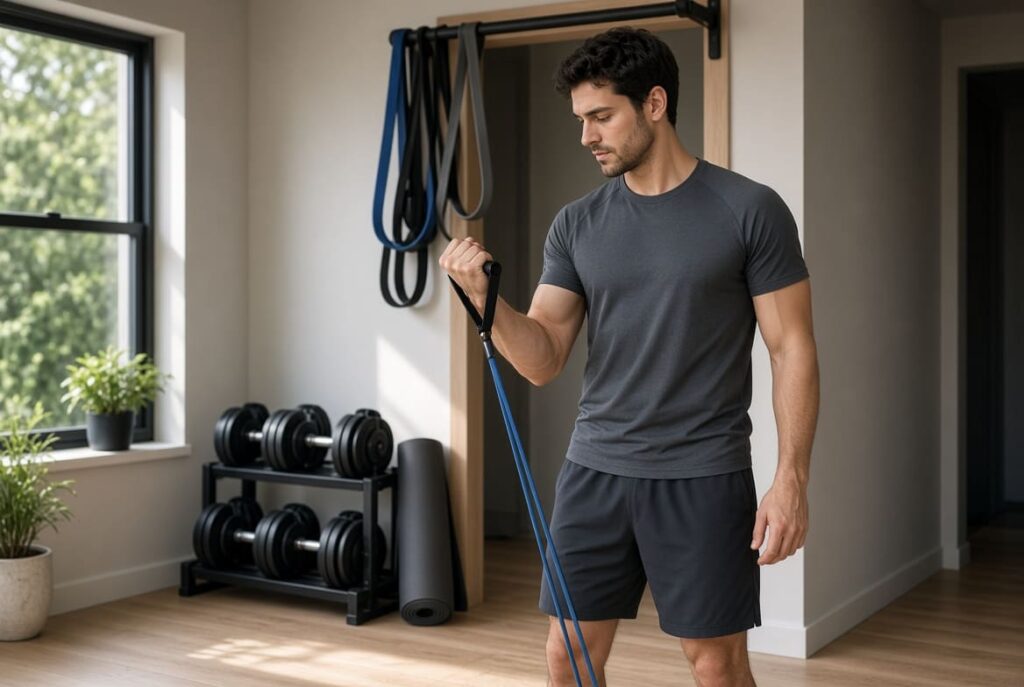
Resistance bands offer a compact, inexpensive way to perform bicep curls, tricep pushdowns, and lateral raises with variable resistance that increases as the band stretches. A simple door anchor attachment allows bands to replicate many cable machine movements without requiring dedicated equipment.
Adjustable dumbbells cover most of the exercises performed on bicep and tricep machines, from curls to overhead extensions, while taking up minimal storage space compared to a full home gym setup.
A doorway pull up bar supports both assisted and unassisted pull up training, directly replicating the back and bicep benefits of the assisted pull up machine found in commercial gyms, though beginners may need resistance bands looped around the bar to reduce the load until they build sufficient strength.
Sample Beginner Arm and Shoulder Workout
This simple routine combines the machines covered in this guide into a balanced beginner friendly session.
Bicep curl machine. Three sets of twelve reps, focusing on slow, controlled movement without swinging.
Tricep pushdown machine. Three sets of twelve reps, keeping your elbows tucked close to your body throughout.
Shoulder press machine. Three sets of ten reps, pressing through a full range of motion without locking your elbows at the top.
Seated row machine. Three sets of twelve reps, squeezing your shoulder blades together at the end of each pull.
Lateral raise machine. Three sets of twelve reps, lifting to shoulder height without using momentum.
Rest sixty to ninety seconds between each set. This routine takes roughly thirty to forty minutes and covers every major arm and shoulder muscle group without requiring advanced technique or heavy loads.
Common Mistakes to Avoid on Arm Machines
Most arm machine injuries and stalled progress come from a handful of repeated mistakes rather than the equipment itself being unsafe.
Using momentum instead of muscle control. Swinging your body on the bicep curl machine or rushing through reps on the tricep pushdown reduces muscle engagement and increases injury risk.
Skipping the elbow position check. Letting your elbows drift away from the pad on curl machines or away from your body on tricep exercises shifts stress onto the shoulders instead of the target muscle.
Training arms every single day. Muscles need recovery time to grow. Training arms two to three times per week with at least one rest day between sessions produces better long term results than daily training.
Ignoring the shoulders entirely. Focusing only on biceps and triceps while skipping shoulder machines creates imbalanced development and increases the risk of shoulder injury over time.
Chasing heavy weight over proper form. Lifting weight you cannot control with good form on any machine, particularly the shoulder press or dip machine, significantly increases injury risk without providing additional muscle building benefit.
FAQs
What are the names of arm workout machines at the gym? Common arm workout equipment names include the bicep curl machine, preacher curl machine, tricep pushdown, tricep dip machine, shoulder press machine, and cable machine attachments for curls and kickbacks.
What machine works the biceps best? The preacher curl machine is often considered the most effective for bicep isolation, since the angled pad prevents momentum and maximizes muscle stretch at the bottom of each rep.
What gym machine is best for triceps? The tricep pushdown machine is one of the most effective options, allowing consistent cable tension throughout the movement while keeping the exercise simple and beginner friendly.
What machine should I use for shoulders? The shoulder press machine is a strong starting point for overall shoulder development, while the lateral raise and rear delt machines target specific deltoid heads for more complete shoulder training.
Is the chest press machine good for arms too? Yes. The chest press machine significantly engages the triceps and front deltoids throughout the pressing motion, making it a useful addition to an arm and shoulder focused routine.
What is the difference between arm machines and free weights? Machines offer a fixed, guided movement path that reduces stabilization demands, making them beginner friendly, while free weights require more stabilizer muscle engagement, building functional strength that carries over to everyday movement.
How often should I train arms and shoulders? Most people see the best results training arms and shoulders two to three times per week, with at least one rest day between sessions to allow proper muscle recovery.
What arm machines are best for beginners? The bicep curl machine, tricep pushdown, and chest press machine are excellent starting points for beginners, since their guided paths simplify proper form while you build foundational strength.
Can I build arm strength at home without machines? Yes. Resistance bands, adjustable dumbbells, and a doorway pull up bar can replicate most of the exercises performed on gym machines effectively for home based arm training.
What is the best machine for toning arms? Cable based equipment, such as the cable bicep curl and cable tricep kickback, works particularly well for toning, since the constant tension builds lean muscle definition when paired with an overall calorie deficit.
Conclusion
Learning the right arm workout equipment names takes the guesswork out of arm day and helps you build a complete, balanced routine instead of focusing on just a few familiar machines. From bicep and tricep focused equipment to often neglected shoulder machines like the lateral raise and rear delt machine, each piece serves a distinct purpose in developing strong, well proportioned arms.
The key takeaway is that no single machine builds complete arm strength on its own. Combining isolation equipment for biceps and triceps with shoulder focused machines and supporting movements like the chest press and seated row produces far better results than repeating the same one or two exercises every session.
As gyms continue refining their equipment lineups through 2026, understanding these machine names will remain valuable, whether you are training independently or working alongside a personal trainer to reach your arm and shoulder strength goals.