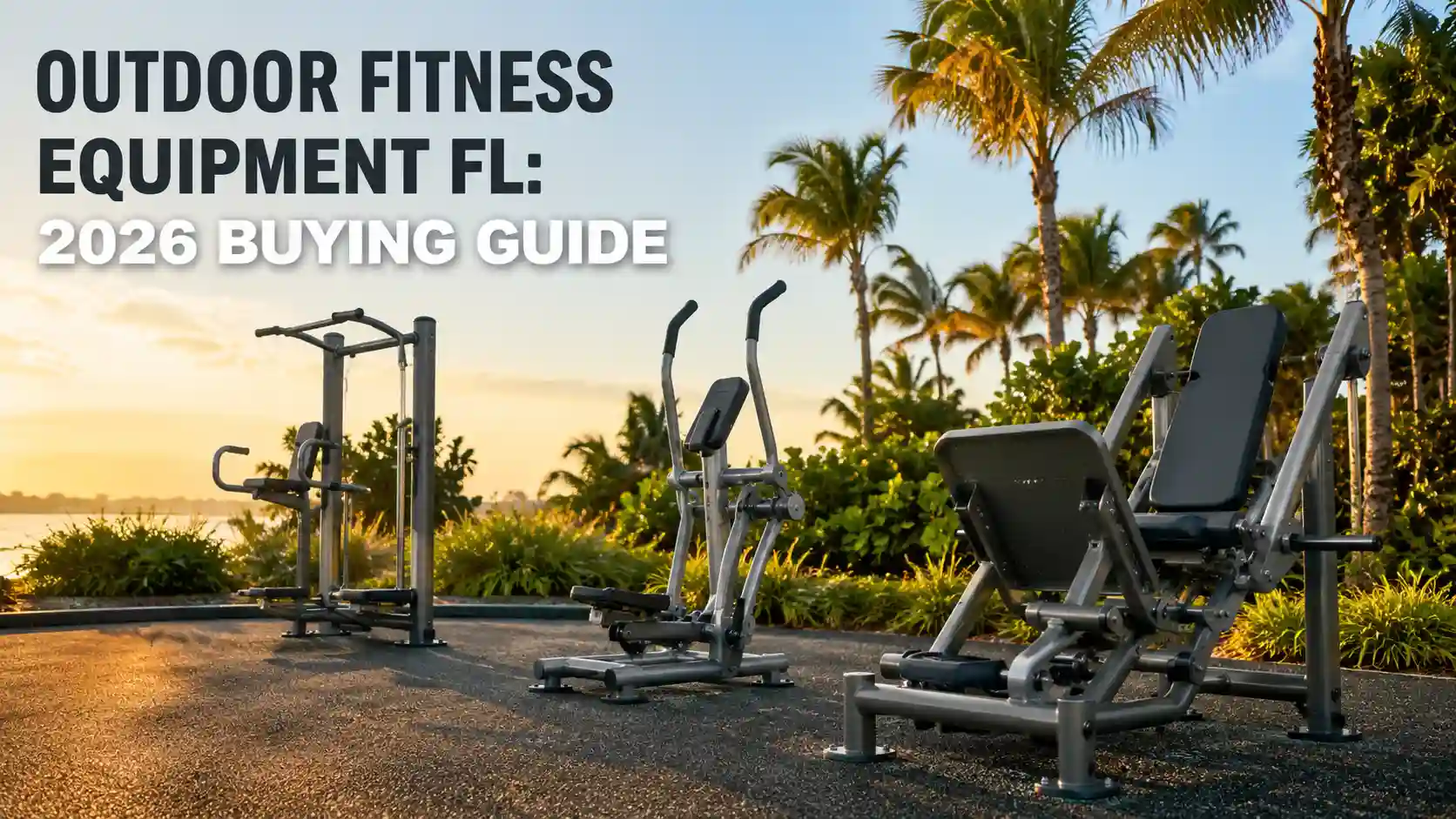
Outdoor Fitness Equipment FL The Complete 2026 Buying Guide
Florida’s sunshine makes outdoor workouts tempting – until the humidity, salt air, and relentless heat wreck a cheap set of equipment within a year. That’s where outdoor fitness equipment FL communities can actually rely on comes in: gear engineered specifically to survive the state’s toughest conditions while delivering a real, gym-quality workout.
Whether you’re a resident scoping out your local park, an HOA planning a community fitness zone, or a municipality sourcing equipment for a new recreation space, choosing the right setup matters. Not all outdoor gym equipment is built the same, and Florida’s climate exposes weak materials fast.
This guide breaks down what outdoor fitness equipment actually is, the equipment types available, the materials that hold up best in Florida, where to find outdoor gyms across the state, and what to look for when buying from a manufacturer – so you can make a confident, informed decision.
What Is Outdoor Fitness Equipment?
Outdoor fitness equipment refers to permanently installed exercise stations designed for public or semi-public spaces – parks, schools, HOAs, and corporate campuses – that let people strength train, do cardio, or work on mobility without stepping inside a gym. Unlike a home gym setup, these stations are built to withstand constant weather exposure and unsupervised public use.
It’s easy to confuse outdoor fitness equipment with playground equipment, but they serve different purposes. Playground gear is designed for children’s unstructured play, while outdoor fitness equipment targets teens, adults, and seniors with structured, biomechanically correct exercises – think resistance training, cardio conditioning, and calisthenics rather than climbing and sliding.
Most commercial-grade stations share a few defining traits:
- Tamperproof construction – welded joints and hidden hardware to resist vandalism
- Weatherproof materials – built to handle rain, sun, and in Florida’s case, salt air and humidity
- Scalable resistance – usable by beginners and experienced athletes alike
- ADA-accessible design – many manufacturers now build inclusive stations that accommodate wheelchair users and people with limited mobility
In short, it’s real strength and cardio equipment, just engineered to live outside permanently.
Why Florida Needs Climate-Specific Equipment
Florida isn’t a forgiving environment for metal and plastic left outside year-round. Between the intense UV exposure, near-constant humidity, and salt air along the coast, standard outdoor equipment can start showing rust, fading, and material breakdown far sooner than it would in a drier or cooler climate.
Three factors make Florida especially demanding:
- Heat and UV exposure. Constant sun degrades plastics, fades powder-coated finishes, and can make metal surfaces uncomfortably hot to the touch during peak afternoon hours.
- Humidity. Florida’s moisture-heavy air accelerates corrosion on any metal that isn’t properly treated, especially around welds, bolts, and moving parts.
- Salt air. For coastal cities like Miami, Fort Lauderdale, and Daytona Beach, airborne salt speeds up rust dramatically – equipment that would last decades inland can fail in just a few years near the coast.
This is why buyers researching outdoor fitness equipment FL options need to look past basic “weather-resistant” marketing claims and ask specific questions about coating processes, hardware grade, and coastal-rated finishes. Suppliers who explicitly reference salt-air testing or coastal installations – rather than generic “all-weather” language – are usually the safer bet for long-term durability in Florida.
The equipment itself isn’t the problem; the wrong materials for the environment are.
Types of Outdoor Fitness Equipment
Outdoor fitness stations generally fall into three categories, and most well-designed community gyms include a mix of all three to serve different fitness goals and ability levels.
Cardio Stations
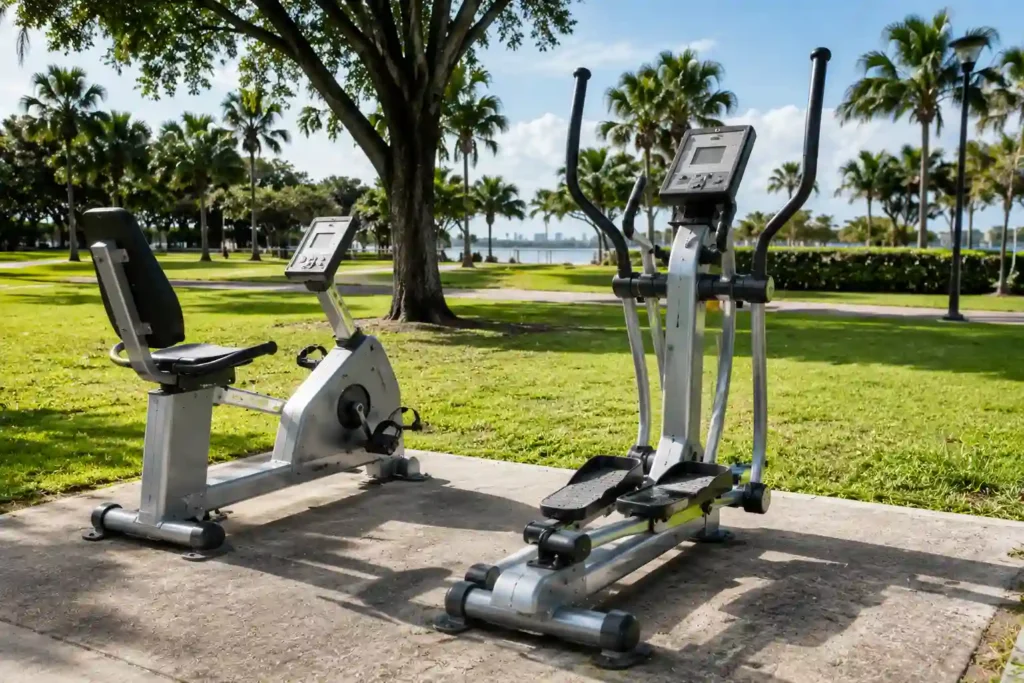
Cardio equipment brings low-impact, joint-friendly conditioning outdoors. Common options include:
- Elliptical trainers – full-body, low-impact movement good for all fitness levels
- Recumbent bikes – seated pedaling stations that are easier on the back and knees
- Steppers – compact stations that mimic stair-climbing for leg and cardio conditioning
These are popular in inclusive community parks since they’re accessible to seniors and beginners while still challenging for more experienced users.
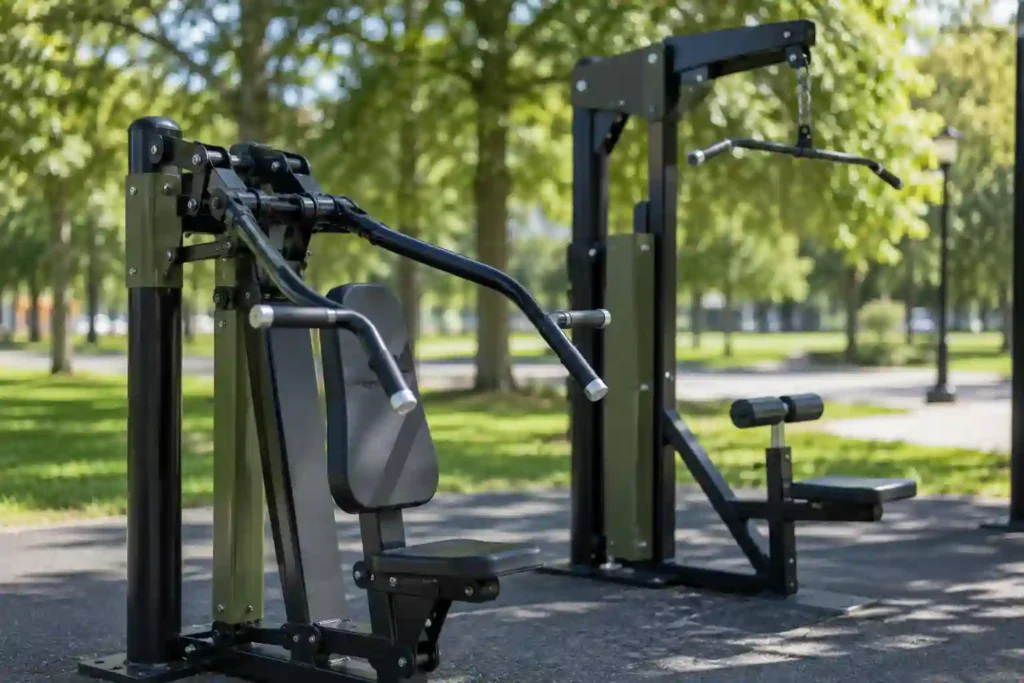
Strength & Resistance Stations
These stations replicate traditional gym machines using body weight or mechanical resistance instead of stacked plates:
- Chest press and lat pulldown stations – upper body strength building
- Leg press stations – lower body strength without free weights
- Captain’s chair / core stations – ab and core-focused movements
Functional & Calisthenics Equipment
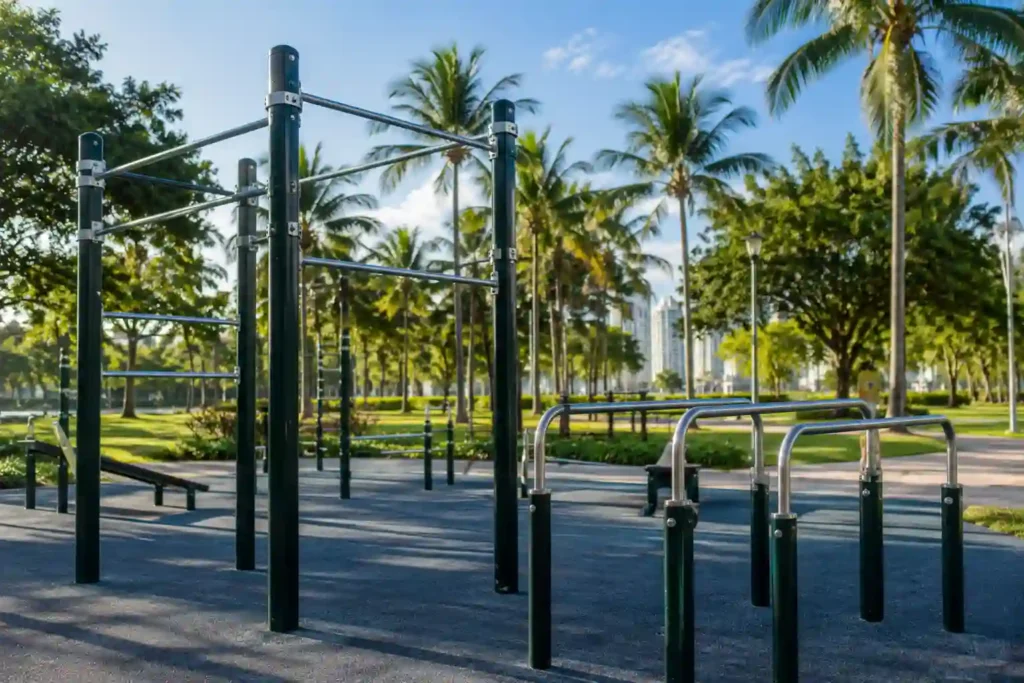
This category has grown fast in popularity, especially with the rise of street workout and bodyweight training:
- Pull-up and dip bars – upper body and core strength
- Parallel bars and monkey bars – grip strength, coordination, upper body control
- Balance beams – stability and functional movement training
Most Florida installations combine cardio, strength, and functional zones into a single “fitness park” layout, giving users a complete workout without needing separate equipment for each muscle group.
Materials That Hold Up in Florida
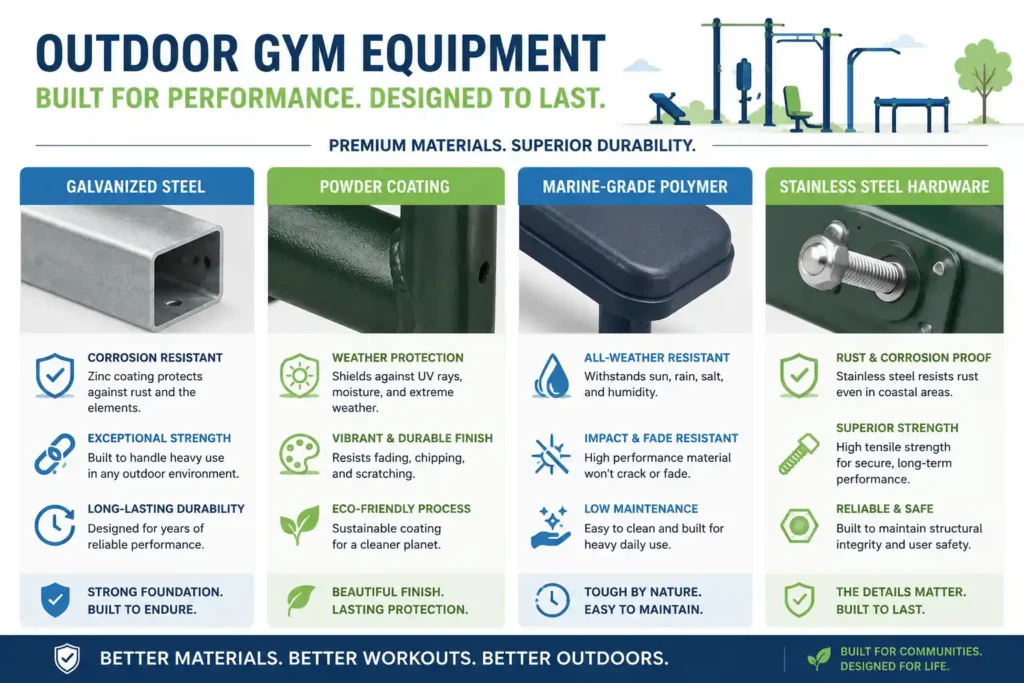
Material choice is the single biggest factor separating outdoor fitness equipment that lasts decades from equipment that rusts out in a few years. In Florida specifically, buyers should pay close attention to four things:
- Galvanized steel. Steel that’s hot-dipped in zinc before fabrication resists rust far better than raw or lightly coated steel. It’s the industry standard for coastal and high-humidity installations.
- Powder coating. A baked-on powder finish (applied after galvanizing, ideally) protects against UV fading and adds a second layer of corrosion resistance. Look for suppliers who blast, prime, and powder-coat every surface rather than just spray-painting.
- Marine-grade polymer and aluminum. Moving parts like pedals, handles, and seats often use aluminum or weather-rated polymer instead of raw steel, since these resist corrosion better in constantly damp conditions.
- Stainless steel hardware. Bolts, fasteners, and pivot points should be stainless steel specifically – regular steel hardware is often the first point of failure, even when the main frame holds up fine.
One detail worth asking suppliers about directly: e-coating, an automotive-grade electrocoating process that’s becoming the new benchmark for coastal fitness equipment. It provides more uniform corrosion protection than traditional powder coating alone, particularly around welds and tight joints where rust typically starts.
A simple gut-check when evaluating a manufacturer: ask to see installations that are 8-10 years old in a humid or coastal environment. If they can’t show you equipment that’s held up that long, treat any “weatherproof” claim with some skepticism.
How to Choose an Outdoor Fitness Equipment Manufacturer
Not every outdoor fitness equipment manufacturer builds for Florida’s conditions, so vetting suppliers properly upfront saves significant money and headaches down the line. Here’s what actually matters when comparing options:
- Coastal or humid-climate references. Ask specifically for installations in Florida or similarly humid, coastal regions – not just generic “nationwide” project lists. A manufacturer with real Gulf Coast or South Florida installs has already solved the problems you’re likely to face.
- Warranty length and coverage. Warranties in this industry commonly range from 2 years up to 10+ years depending on the manufacturer and component. Pay attention to what’s actually covered – frame integrity, coating, and moving parts often have different warranty terms.
- ADA compliance and inclusive design. If you’re buying for a public space (park, school, HOA common area), ADA-accessible stations aren’t optional in most cases. Confirm this upfront rather than assuming.
- Installation support. Some manufacturers handle full installation; others ship equipment for self-install or third-party contractors. Know which model you’re getting into before comparing prices, since installation costs can shift the total budget significantly.
- Maintenance documentation. Reputable suppliers provide clear inspection checklists (bolt tightness, coating condition, pivot points) rather than vague “low-maintenance” claims with no specifics.
For municipal or HOA buyers specifically, it’s worth requesting a written maintenance and inspection plan as part of any quote – this becomes useful documentation for budgeting and liability purposes down the road, and it’s a good signal of how seriously a manufacturer takes long-term durability versus just closing the sale.
Where to Find Outdoor Gyms in Florida
Florida has no shortage of public outdoor fitness spaces, especially in coastal and urban areas. Here are a few standout examples across the state:
- Orlando area. The City of Orlando maintains fitness stations across multiple parks throughout the city, making outdoor workouts easily accessible for residents without needing a gym membership.
- South Beach, Miami. Muscle Beach in South Beach is a well-known fitness spot recognized for its lively atmosphere and varied workout equipment, including pull-up and parallel bars suited to all fitness levels. Yelp
- Coral Springs. Betti Stradling Park offers equipment ranging from elliptical machines to resistance bands for a full-body workout. Yelp
- Boca Raton. Calisthenics in American Homes Park features monkey bars and dip stations set within green, wooded surroundings. Yelp
- Fort Lauderdale. A beachside calisthenics park here includes sand-filled bags and TRX straps, offering ocean views alongside the workout. Yelp
- Davie. Vista View Park combines expansive green space and scenic trails for outdoor training. Yelp
Beyond these specific parks, most mid-to-large Florida cities – Tampa, Daytona Beach, Gainesville, Ocala, and Melbourne among them – have at least one public park with installed fitness stations. A quick search for “[your city] outdoor fitness stations” or checking your city’s parks and recreation website is usually the fastest way to find the closest option.
For HOAs and municipalities considering their own installation, visiting a few of these existing parks in person is a smart research step – it gives a real sense of how equipment holds up after years of Florida weather exposure, not just how it looks on a manufacturer’s website.
Cost & Installation Considerations
Pricing for outdoor fitness equipment varies widely depending on the station type, materials, and whether you’re buying a single unit or outfitting a full fitness park. Individual commercial-grade stations – things like leg press or lat pulldown units – commonly run in the $5,000-$6,500+ range per station, while simpler stations like pull-up bars or parallel bars tend to cost less. A full multi-station outdoor gym easily runs into the tens of thousands once you factor in several stations plus surfacing.
A few cost factors worth planning for beyond the equipment itself:
- Installation. Some manufacturers include professional installation in their pricing; others charge separately or offer self-install options with guidance. Installation costs scale with the number of stations and site conditions.
- Surfacing. Safety surfacing (rubber tiles, poured rubber, or engineered wood fiber) is often required under and around equipment, and this is frequently underestimated in budget planning.
- Site prep. Concrete footings, drainage, and ground leveling can add meaningful cost, especially on uneven or sandy sites common in parts of Florida.
- Long-term maintenance. Budgeting a small annual amount for inspections and part replacement is smarter than treating maintenance as a one-time afterthought.
Getting itemized quotes from at least two or three manufacturers – broken down by equipment, installation, and surfacing separately – makes it much easier to compare true total cost rather than just sticker price.
Maintenance in Florida’s Climate
Even the best materials need regular upkeep, and Florida’s climate makes maintenance more important than it would be in milder regions. Skipping inspections doesn’t just shorten equipment lifespan – it can create real safety risks for users.
A solid maintenance routine typically includes:
- Quarterly inspections. Most manufacturers recommend checking pivot points, surface coatings, and bolt tightness at least four times a year – more often in coastal areas with heavy salt exposure.
- Rust monitoring. Catching small rust spots early, especially around welds and hardware, prevents them from spreading into structural issues.
- Hardware checks. Bolts and fasteners loosen with heavy use and temperature fluctuation, so tightening checks should be part of every inspection cycle.
- Cleaning. Rinsing off salt residue, pollen, and grime periodically helps protect powder-coated finishes and extends their lifespan.
- Coating touch-ups. Small chips or scratches in the coating should be addressed quickly, since exposed metal underneath is where corrosion typically starts.
For municipalities and HOAs, keeping a written inspection log isn’t just good practice – it’s also useful documentation if liability questions ever come up. Many manufacturers provide a maintenance checklist template as part of the purchase, so it’s worth asking for one upfront rather than creating your own from scratch.
The bottom line: equipment built with the right materials (galvanized steel, powder coating, stainless hardware) combined with consistent quarterly maintenance can realistically last a decade or more, even in Florida’s tougher coastal environments.
Beginner Tips for Using Outdoor Fitness Equipment
Outdoor fitness stations are approachable for beginners, but Florida’s heat adds a few extra considerations that gym-goers don’t usually have to think about indoors.
- Time your workouts. Early morning or evening sessions avoid peak heat and direct sun, making workouts more comfortable and safer, especially in summer months.
- Hydrate before you start. Don’t wait until you feel thirsty – Florida humidity increases fluid loss through sweat even during moderate exercise.
- Check equipment temperature. Metal surfaces left in direct sun can get uncomfortably hot; a quick touch test before grabbing a bar or seat is a good habit.
- Start with bodyweight movements. Stations like pull-up bars, dip bars, and parallel bars let you scale intensity by adjusting reps or using assisted variations, making them beginner-friendly without extra equipment.
- Use shaded stations when available. Many parks position at least some equipment under tree cover – a good starting point if you’re new to outdoor workouts and still adjusting to the heat.
- Wear sun protection. Sunscreen and a hat go a long way during longer outdoor sessions, particularly around midday.
Outdoor fitness equipment is designed to be intuitive – most stations include instructional signage or QR codes linking to exercise demonstrations, so first-time users aren’t left guessing how to use a station correctly.
Frequently Asked Questions
What is outdoor fitness equipment called?
It’s commonly referred to as outdoor gym equipment, outdoor fitness stations, or park fitness equipment. These terms all describe permanently installed exercise stations built for public spaces like parks, schools, and community areas, designed for structured cardio, strength, and calisthenics workouts.
Is outdoor fitness equipment free to use in Florida parks?
Yes, most outdoor fitness equipment in public Florida parks is free to use. Cities like Orlando maintain fitness stations across multiple park locations at no cost to residents, making it an accessible alternative to a paid gym membership.
What materials are best for outdoor gym equipment in hot, humid climates?
Galvanized steel, powder-coated finishes, marine-grade polymer, and stainless steel hardware hold up best. These materials resist rust, UV fading, and corrosion from humidity and salt air, all common challenges in Florida’s climate.
How much does outdoor fitness equipment cost?
Individual commercial-grade stations typically range from $5,000-$6,500 or more, depending on the equipment type. A full multi-station outdoor gym, including surfacing and installation, can run into the tens of thousands of dollars.
Can outdoor fitness equipment be installed in a backyard?
Yes, several manufacturers offer residential-scale outdoor fitness equipment designed for backyards, including compact functional trainers, pull-up stations, and cardio machines built for private use rather than public installations.
Is outdoor gym equipment safe in the rain?
Most commercial-grade outdoor fitness equipment is designed to handle rain safely, but wet surfaces can become slippery. It’s best to wait for surfaces to dry or use caution with grip-dependent stations like pull-up bars after rainfall.
How long does outdoor fitness equipment last?
Well-built equipment using galvanized steel and powder coating, combined with regular maintenance, can last a decade or more, even in coastal Florida environments. Lower-quality materials without proper coatings often fail within just a few years.
What’s the difference between outdoor fitness equipment and playground equipment?
Outdoor fitness equipment targets teens, adults, and seniors with structured strength and cardio exercises, while playground equipment is designed for children’s unstructured play, like climbing and sliding, with different safety and design standards.
Where can I find outdoor gyms near me in Florida?
Most mid-to-large Florida cities have at least one park with fitness stations. Checking your city’s parks and recreation website, or searching “[your city] outdoor fitness stations,” is the fastest way to locate the nearest option.
Do outdoor fitness stations work for beginners?
Yes, most stations are designed with scalable resistance and bodyweight-based movements, making them accessible for beginners while still challenging for experienced users. Instructional signage or QR codes at many stations also help first-time users learn proper form.
Conclusion
Outdoor fitness equipment gives Florida residents, HOAs, and municipalities a way to bring real, gym-quality workouts into public and community spaces, but the state’s heat, humidity, and salt air make material choice non-negotiable. Equipment built with galvanized steel, powder coating, and stainless hardware, paired with consistent quarterly maintenance, is what separates a fitness park that lasts a decade from one that rusts out in a few years.
Whether you’re a resident exploring your nearest park or a buyer comparing manufacturers for a new installation, the same principle applies: prioritize coastal-tested materials and transparent warranty terms over marketing claims alone. As outdoor fitness continues to grow in popularity across Florida through 2026 and beyond, the communities that invest in the right outdoor fitness equipment FL buyers can trust will see the biggest long-term payoff – both in equipment longevity and resident engagement.